
Post written by Aamir Saeed, MD, from the University of Tennessee Health Sciences Center, Memphis, Tennessee, and Faisal Kamal, MD, from the Division of Gastroenterology and Hepatology, Thomas Jefferson University Hospital, Philadelphia, Pennsylvania, USA.

We conducted a systematic review and meta-analysis to evaluate the predictors of post-ERCP bleeding. We also performed subgroup analyses to identify risk factors for postsphincterotomy bleeding and postendoscopic papillectomy bleeding.
ERCP is an essential tool for managing pancreaticobiliary disorders. Despite its therapeutic benefits, ERCP is associated with various adverse events, including post-ERCP pancreatitis, bleeding, perforation, and acute cholangitis. Post-ERCP bleeding is a significant adverse event with a reported incidence of 1% to 2%.
Accurate identification of these risk factors is crucial to enhancing procedural safety. Recognizing high-risk patients can inform decisions to delay or avoid ERCP when appropriate or to implement pharmacologic measures to minimize bleeding risk.
Twenty-seven studies (4 prospective and 23 retrospective studies) comprising 149,870 patients were included in the final analysis; 1865 experienced post-ERCP bleeding. We analyzed 20 potential risk factors, including sociodemographic, medication-, comorbidity-, procedure indication-, and procedure-related factors.
We found several factors significantly associated with increased odds of post-ERCP bleeding in the pooled adjusted analysis, including male gender (OR, 1.24; 95% CI, 1.05-1.46), anticoagulation therapy (OR, 2.75; 95% CI, 1.66-4.56), cirrhosis (OR, 2.54; 95% CI, 1.76-3.65), hemodialysis (OR, 5.82; 95% CI, 3.32-10.18), coagulopathy (OR, 11.01; 95% CI, 2.50-48.40), endoscopic sphincterotomy (OR, 3.19; 95% CI, 1.69-6.01), precut sphincterotomy (OR, 2.24; 95% CI, 1.52-3.30), and intraoperative bleeding (OR, 2.57; 95% CI, 1.80-3.66).
This meta-analysis identified anticoagulation therapy, cirrhosis, hemodialysis, coagulation disorder, endoscopic sphincterotomy, precut sphincterotomy, and male gender as associated with increased odds of post-ERCP bleeding in the pooled adjusted analysis. Conversely, age, high body mass index, cholangitis, choledocholithiasis, pancreatic duct stones, needle-knife sphincterotomy, nonsteroidal anti-inflammatory drug use, and antiplatelet therapy were not significantly associated with higher odds of post-ERCP bleeding in the pooled adjusted analysis.
Incorporating our results into a prediction model may help identify patients at increased risk, optimize informed consent, and guide prevention and management strategies for post-ERCP bleeding.
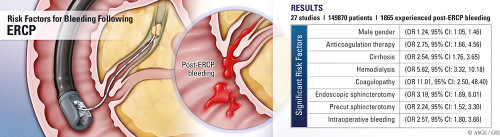
Graphical abstract
Read the full article online.
The information presented in Endoscopedia reflects the opinions of the authors and does not represent the position of the American Society for Gastrointestinal Endoscopy (ASGE). ASGE expressly disclaims any warranties or guarantees, expressed or implied, and is not liable for damages of any kind in connection with the material, information, or procedures set forth.

