Post written by Soma Fukuda, MD, from the Department of Gastroenterology, Institute of Medicine, University of Tsukuba, Ibaraki, Japan.

We present a case of obstructive pancreatitis in a 70-year-old woman with pancreatic head cancer undergoing chemotherapy. Transpapillary pancreatic duct drainage failed because of complete ductal obstruction by the tumor.
EUS-guided pancreatic duct drainage was therefore attempted; however, the main pancreatic duct in the pancreatic tail was obscured by isoechoic debris on B-mode imaging, making safe puncture difficult. Contrast-enhanced harmonic EUS clearly delineated the main pancreatic duct as an avascular structure, whereas color Doppler helped identify peripancreatic vessels. Under real-time contrast-enhanced harmonic EUS guidance, the obscured duct was successfully punctured, and a plastic stent was placed from the main pancreatic duct to the stomach. The patient improved without adverse events.
EUS-guided pancreatic duct drainage is technically demanding because the main pancreatic duct is a small target, and precise visualization is essential. In some cases, debris, inflammation, or tumor-related changes can make the duct difficult to distinguish from the surrounding pancreatic parenchyma on conventional B-mode imaging. This video was important to showcase because it demonstrates how contrast-enhanced harmonic EUS can provide a practical “black-and-white” roadmap for ductal puncture, and color Doppler complements this by mapping vessels.
Other endoscopists can learn that contrast-enhanced harmonic EUS may be useful when the main pancreatic duct is obscured on B-mode imaging. The key lesson is to avoid relying on 1 imaging mode alone in difficult cases. A dual-imaging strategy, using color Doppler for vascular mapping and contrast-enhanced harmonic EUS for ductal visualization, may improve the safety and feasibility of challenging EUS-guided pancreatic duct drainage.
To our knowledge, this is the first report to highlight the practical use of contrast-enhanced harmonic EUS as a troubleshooting tool during EUS-guided pancreatic duct drainage when the main pancreatic duct is obscured.
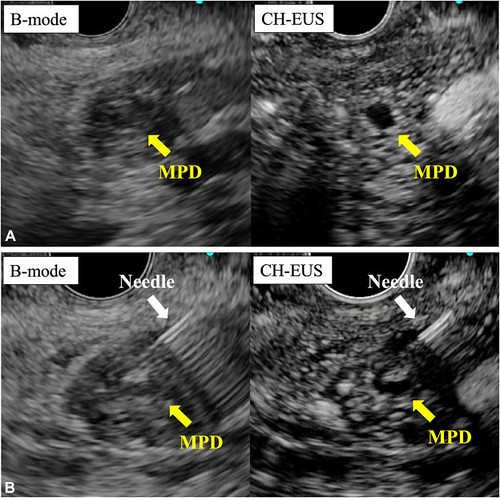
Main pancreatic duct (MPD) puncture under contrast-enhanced harmonic EUS (CH-EUS) guidance. A, Although the MPD is poorly visualized on B-mode, CH-EUS clearly delineates the 3.2-mm-diameter duct as an avascular structure. B, Real-time visualization of the 22-gauge needle accurately entering the obscured MPD under CH-EUS guidance.
Read the full article online.
The information presented in Endoscopedia reflects the opinions of the authors and does not represent the position of the American Society for Gastrointestinal Endoscopy (ASGE). ASGE expressly disclaims any warranties or guarantees, expressed or implied, and is not liable for damages of any kind in connection with the material, information, or procedures set forth.

