
Post written by Mohan Kumar Ramchandani, MD, DM, Priscilla Vanesa Lopez, MD, MS, and Pradev Inavolu, MD, DM, from the Asian Institute of Gastroenterology Hospitals, Hyderabad, India.

Endoscopic resection of duodenal lesions remains technically demanding because of the thin duodenal wall, narrow lumen, complex anatomy, and exposure to bile and pancreatic secretions. We evaluated the safety and effectiveness of endoscopic submucosal dissection (ESD) and freehand endoscopic full-thickness resection (EFTR) for duodenal epithelial and subepithelial lesions, with particular attention to predictors of adverse events and the role of a structured closure strategy.

Although ESD and EFTR are well established in other regions of the GI tract, their application in the duodenum remains largely confined to expert centers because of concerns regarding bleeding and perforation. Nevertheless, these techniques offer the potential for organ-preserving treatment and may obviate the need for more extensive surgery in appropriately selected patients. We were particularly interested in identifying endoscopic features that could alert the operator to a potentially difficult resection and determining whether a structured approach to defect closure and postprocedural care could reduce delayed adverse events.

We performed 109 resections in 101 patients, including 15 epithelial and 94 subepithelial lesions (Fig. 1). Technical success was 98.2%, with R0 resection achieved in 93.3% of epithelial lesions and 90.4% of subepithelial lesions. Freehand EFTR was required in 16 cases, mainly because of muscularis propria involvement or severe fibrosis.
Beyond these technical outcomes, we feel the study adds 2 clinically useful observations. First, severe submucosal fibrosis was the only independent predictor of procedural adverse events in subepithelial lesions, and it was significantly associated with surface ulceration. This suggests that ulceration may serve as a useful warning sign of underlying fibrosis and a potentially more difficult resection.
Second, our experience highlights the importance of a structured closure strategy. Defects were closed using clips alone or loop-and-clip closure according to defect size, location, fibrosis, and tissue characteristics. Complete closure was achieved in 97.2% of cases, whereas delayed adverse events occurred in only 2.8%. We believe the low rate of delayed events reflects not only the closure technique itself but the overall protocol of careful defect assessment, stepwise closure, close observation, selective imaging when needed, and gradual refeeding.
The main limitation is that epithelial lesions were few, and all procedures were performed by experienced endoscopists at a single high-volume center. The next step should therefore be prospective multicenter evaluation, including operators with different levels of experience, to assess how reproducible these outcomes and the structured closure protocol are in broader practice. Longer follow-up also will be important, particularly for neuroendocrine tumors.
A broader lesson from this study is that successful duodenal resection depends on more than the resection technique alone. Careful lesion assessment, recognition of high-risk features such as ulceration and severe fibrosis, secure defect closure, and structured postprocedural care all influence outcomes. We hope these findings support a more protocol-based approach to duodenal ESD and EFTR and offer a framework for evaluation at other centers.
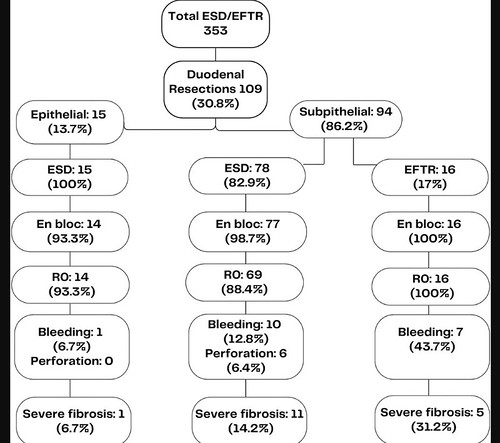
Flowchart illustrating study outcomes of endoscopic submucosal dissection (ESD) and freehand endoscopic full-thickness resection (EFTR) for resection of epithelial and subepithelial lesions in the duodenum. R0, Resection with histologically tumor-free lateral and vertical margins.
Read the full article online.
The information presented in Endoscopedia reflects the opinions of the authors and does not represent the position of the American Society for Gastrointestinal Endoscopy (ASGE). ASGE expressly disclaims any warranties or guarantees, expressed or implied, and is not liable for damages of any kind in connection with the material, information, or procedures set forth.

