
Post written by Michael Lajin, MD, from Sharp HealthCare, La Mesa, California, USA.

In this case series, we present 3 patients who underwent EUS-directed transenteric ERCP (EDEE) (2 with Roux-en-Y hepaticojejunostomy [RYHJ] and 1 with Roux-en-Y distal gastrectomy) to treat biliary strictures or stones or to replace percutaneous transhepatic biliary drainage (PTBD) with endoscopic stent placement. We highlighted the technical differences between RYHJ and Roux-en-Y gastrectomy, as well as different methods for distending the targeted small-bowel loop.
The biliary orifice was easily accessed, and biliary interventions were successfully performed in all patients using the necessary accessories. The patient with Roux-en-Y distal gastrectomy had large impacted stones, a challenging scenario even with normal anatomy. With creation of a short route (similar to Billroth II), EDEE enabled the use of a dedicated duodenoscope and a cholangioscope with electrohydraulic lithotripsy, allowing efficient, complete bile duct clearance. There were no adverse events directly related to the procedures.
Nongastric bypass Roux-en-Y reconstruction poses a challenge for endoscopic biliary interventions because it separates the alimentary limb (where the endoscope is inserted) from the biliary limb that leads to the biliary tree (the target for intervention). Traditionally, biliary interventions assisted by enteroscopy and percutaneous methods have been used to avoid surgery.
Enteroscopy-assisted ERCP poses 2 challenges: access and execution (using a nondedicated endoscope results in difficult cannulation, unstable positioning, and an inability to use certain tools). These procedures often require a longer time with the patient under anesthesia and have a higher risk of failure than conventional ERCP. PTBD carries the risks of bleeding, drain dislodgment, obstruction, and leakage. It can be cumbersome for patients and may adversely affect their quality of life.
EUS-guided enteroenteric anastomosis connects the alimentary limb to the biliary limb, helping address both access and execution challenges. By creating a short route, EDEE facilitates access to the biliary orifice with a dedicated duodenoscope, enabling cannulation and use of necessary accessory devices and allowing repeated, simple reintervention with shorter anesthesia exposure for the patient.
There are 2 technical variants for EDEE: (1) in RYHJ, the alimentary limb (naïve antrum/duodenum) is connected (during EDEE) to the biliary limb near the hepaticojejunostomy; (2) in Roux-en-Y gastrectomy, the alimentary limb (stomach/jejunum) is connected (during EDEE) to the biliary limb near the ligament of Treitz.
Multiple methods are available to identify and distend the targeted small bowel: (1) if the patient has pre-existing PTBD, the drain is replaced with an 8F catheter without side holes connected to an auxiliary pump for saline and contrast instillation; (2) if the targeted loop is visible, it is punctured directly with a 19-gauge needle connected to an auxiliary pump; (3) otherwise, an EUS-guided transhepatic approach can be performed by puncturing a left intrahepatic duct with a 19-gauge needle and injecting contrast to opacify the targeted small-bowel loop; this method requires prompt drainage of the injected biliary tree through a 1-step EDEE, EUS-guided hepaticogastrostomy, or temporary PTBD; (4) if enteroscopy-assisted ERCP fails, but the enteroscope reaches the biliary limb, a catheter-based approach can be used to facilitate EDEE.
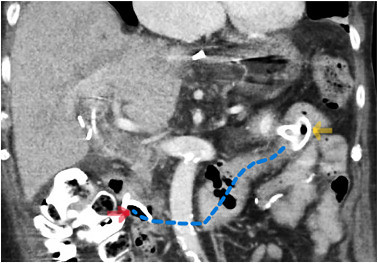
Patient 1: postoperative CT demonstrating the enteroenterostomy (yellow arrow), creating a short retrograde route (blue dotted line) to the papilla (red arrow).
Read the full article online.
The information presented in Endoscopedia reflects the opinions of the authors and does not represent the position of the American Society for Gastrointestinal Endoscopy (ASGE). ASGE expressly disclaims any warranties or guarantees, expressed or implied, and is not liable for damages of any kind in connection with the material, information, or procedures set forth.

