
Post written by Phillip S. Ge, MD, FASGE, from The University of Texas MD Anderson Cancer Center, Houston, Texas, USA.

The focus of our study was to evaluate the performance of magnetic resonance imaging (MRI) in the initial staging of large rectal polyps in patients who were initially referred for colorectal surgery and subsequently referred for diagnostic endoscopic resection as an organ-sparing alternative to surgical resection following multidisciplinary discussion.
Patients diagnosed with large rectal polyps are frequently referred to colorectal surgery under the clinical assumption that these polyps are malignant–even when biopsies indicate adenoma. In our experience, this practice continues to be commonplace despite knowledge of endoscopic resection techniques such as endoscopic submucosal dissection; referring gastroenterologists simply do not seem to believe these lesions could possibly be benign, or that they may be endoscopically resectable.
These patients who are referred to colorectal surgery then routinely undergo MRI per National Comprehensive Cancer Network rectal cancer guidelines. If MRI overstages these lesions, there are significant clinical implications with regard to what treatment is recommended to the patient. After anecdotally noticing multiple instances when MRI overstaged large adenomas, we realized a critical need to examine the performance characteristics of MRI in this population.
Over a 7-year period from 2018 to 2025, a total of 44 patients with large rectal polyps (mean size 5.8 cm, full range 2-18 cm) were referred from colorectal surgery to us for endoscopic resection. In that very specific population of patients who would have otherwise gone to surgery, MRI overstaged 18 of 44 (40.9%) of lesions.
To be honest, although everybody on the tumor board knew that MRI overstages lesions, nobody realized the magnitude of this problem. This has tremendous clinical implications for patient care. Especially as endoscopic resection techniques such as endoscopic submucosal dissection become increasingly relevant in the United States, endoscopists are increasingly finding themselves at the center of these multidisciplinary conversations. Ultimately, only 13 of 44 (29.6%) of these lesions actually contained submucosally invasive adenocarcinomas, a finding that fundamentally challenges longheld clinical assumptions that large rectal polyps are malignant and should be sent to surgery.
We invite our readers to also take note of the insightful editorial written by Dr Brett J. Hoskins that accompanies this article.
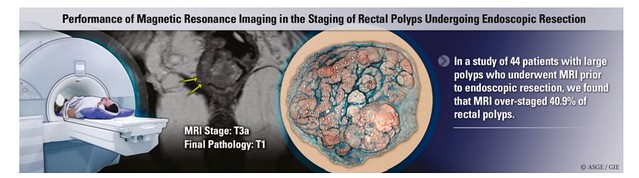
Graphical abstract
Read the full article online.
The information presented in Endoscopedia reflects the opinions of the authors and does not represent the position of the American Society for Gastrointestinal Endoscopy (ASGE). ASGE expressly disclaims any warranties or guarantees, expressed or implied, and is not liable for damages of any kind in connection with the material, information, or procedures set forth.

