
Post written by Rahul Karna, MD, and Stuart K. Amateau, MD, PhD, FASGE, FACG, AGAF, from the University of Minnesota Medical Center, Minneapolis, Minnesota, USA.

Our article highlights a case of an 80-year-old white woman who presented for evaluation of biliary obstruction in the setting of indeterminate gastric outlet obstruction. The accompanying video demonstrates use of a novel fully covered self-expandable metal stent (FCSEMS) with biflanged ends (Resilience; Merit Medical, South Jordan, Utah, USA) across the duodenal stenosis, allowing tissue sampling and biliary access and stent placement through the stent for biliary decompression.

In this patient, initial attempts were made to traverse the stricture and access the ampulla through a 15-mm x 15-mm lumen-apposing metal stent. Despite use of duodenoscopes of varying caliber and patient repositioning, the ampulla could not be reached.
All prior attempts at sampling the stricture had returned benign or nondiagnostic results, and management of gastric outlet obstruction required additional consideration for the lack of tissue diagnosis. The patient was yet to be considered a candidate for an uncovered self-expandable metal stent or a gastroenterostomy due to lack of confirmatory diagnosis. Moreover, ampullary access for ERCP would not have been feasible after placement of FCSEMSs across the duodenal stenosis.
Thus, after multidisciplinary discussion, it was decided to place a novel FCSEMS with biflanged ends (midbody diameter: 20 mm; flare diameter: 28 mm) across the duodenal stenosis, allowing ampullary access for biopsy of an ampullary mass and ERCP for biliary decompression. The shorter overall stent length enabled precise therapy of duodenal stenosis, and the wide caliber of the stent permitted duodenoscope maneuverability and sphincterotome bowing to facilitate successful ERCP.
The novel FCSEMS with biflanged ends can be used in patients with benign or indeterminate gastroduodenal stenosis. The biflanged ends on the FCSEMS may potentially provide antimigratory properties, a concern for currently available covered metal stents for management of luminal obstruction.
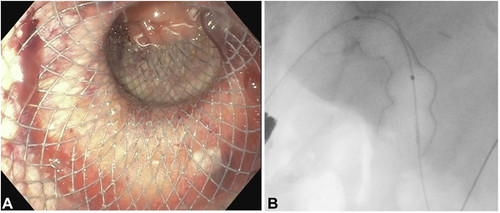
Endoscopic view (A) and fluoroscopic image (B) of the fully covered self-expandable metal stent with biflanged ends, allowing ampullary access and ERCP in a patient traversing the stenosis.
Read the full article online.
The information presented in Endoscopedia reflects the opinions of the authors and does not represent the position of the American Society for Gastrointestinal Endoscopy (ASGE). ASGE expressly disclaims any warranties or guarantees, expressed or implied, and is not liable for damages of any kind in connection with the material, information, or procedures set forth.

