
Post written by Rinrada Worapongpaiboon, MD, and Clement Wu, MD, from the Division of Gastroenterology and Hepatology, Johns Hopkins Medicine, Baltimore, Maryland, USA, Kasenee Tiankanon, MD, from the Division of Gastroenterology and Hepatology, Johns Hopkins Medicine, and Division of Gastroenterology, Department of Medicine, King Chulalongkorn Memorial Hospital and Chulalongkorn University, Bangkok, Thailand, and Saowanee Ngamruengphong, MD, from the Division of Gastroenterology and Hepatology, Johns Hopkins Medicine.

A 49-year-old woman with familial adenomatous polyposis was referred for endoscopic resection of a 4-cm gastric adenoma with high-grade dysplasia arising amid diffuse fundic gland polyposis. A previous endoscopic submucosal dissection (ESD) attempt at an outside hospital was aborted because dense polyposis prevented safe extension of the mucosal incision. During our procedure, we encountered the same challenge: the surrounding fundic gland polyps obscured visualization of the needle-knife tip and limited access to the submucosal layer, making conventional mucosal flap creation impossible.
To overcome this obstacle, we first performed proximal EMR under saline immersion to create a submucosal entry point before initiating traction-assisted ESD. This simple modification provided adequate visualization and access to the submucosal plane, allowing successful en bloc, R0 resection without adverse events. Surveillance endoscopy at 3 months demonstrated a well-healed scar with no evidence of local recurrence.
ESD in patients with familial adenomatous polyposis and diffuse fundic gland polyposis is uncommon and technically challenging. Although traction methods and specialized ESD knives have been described, to our knowledge, there is limited guidance on managing cases in which dense polyposis itself prevents access to the submucosal layer. We wanted to share a simple, reproducible technique that may help endoscopists overcome this specific technical obstacle.
One of the key lessons from this case is the importance of adapting procedural strategy to the patient’s anatomy. When conventional mucosal flap creation is infeasible because of dense fundic gland polyposis, selective EMR of adjacent benign polyps can create a safe submucosal entry point and improve visualization for subsequent ESD.
We also found several technical modifications to be helpful in this setting, including using coagulation forceps for more-visible lesion marking, performing saline-immersion EMR to establish an initial working space, and combining traction-assisted ESD to maintain exposure during dissection. These simple modifications may help endoscopists safely perform ESD in anatomically challenging cases.
Innovation in therapeutic endoscopy does not always require new devices. Sometimes, combining established techniques in a thoughtful way can overcome unexpected procedural challenges. We hope this video encourages endoscopists to remain flexible during complex procedures and provides a practical strategy for managing gastric neoplasms arising amid diffuse fundic gland polyposis.
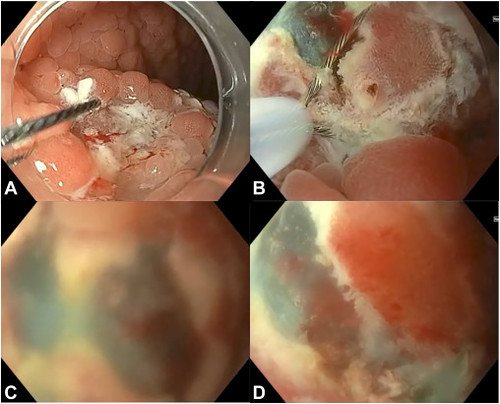
Proximal EMR creating a 3-cm submucosal entry. A, Proximal EMR performed to create an initial mucosal defect for entry into the submucosal space. B, After entering the submucosal space, additional lateral EMR is performed to further widen the mucosal opening. C, Continued EMR is performed to expand the mucosal opening and create a wider submucosal working space. D, A 3- × 1-cm area of the submucosal entry created by EMR.
Read the full article online.
The information presented in Endoscopedia reflects the opinions of the authors and does not represent the position of the American Society for Gastrointestinal Endoscopy (ASGE). ASGE expressly disclaims any warranties or guarantees, expressed or implied, and is not liable for damages of any kind in connection with the material, information, or procedures set forth.

