
Post written by Atsushi Inaba, MD, PhD, and Tomohiro Kadota, MD, PhD, from the Department of Gastroenterology and Endoscopy, National Cancer Center Hospital East, Kashiwa, Japan.
This study focused on long-term clinical outcomes after endoscopic submucosal dissection (ESD) for entire circumferential cT1aN0M0 esophageal squamous cell carcinoma compared with those after esophagectomy and definitive chemoradiotherapy (dCRT).
ESD is a minimally invasive and effective treatment for superficial esophageal squamous cell carcinoma and enables en bloc resection even for entire circumferential esophageal squamous cell carcinoma (EC-ESCC). However, ESD for EC-ESCC frequently results in refractory esophageal stricture, which can substantially affect patients’ quality of life and may limit the choice of additional treatment after noncurative resection.
Therefore, the indication for ESD with these lesions remains controversial, and esophagectomy or dCRT may be selected as an alternative treatment. Because long-term outcomes after these treatment strategies had not been sufficiently clarified, we felt it was important to evaluate their clinical courses over a long follow-up period.
Among 59 patients with EC-ESCC, 28 underwent ESD, 15 esophagectomy, and 16 dCRT as initial treatment. During a median follow-up of 95 months, the 5-year overall survival rates were 92.9%, 86.7%, and 75.0%, respectively. ESD achieved a 100% en bloc resection rate and a 75% curative resection rate. However, esophageal stricture occurred in 79% of patients after ESD, and 46% developed refractory stricture.
Our study provides long-term clinical outcomes of the 3 treatment strategies for EC-ESCC. To further explore the potential indications for ESD, we classified patients who underwent ESD into 4 groups (groups A-D) according to pretreatment tumor depth and longitudinal tumor length and evaluated the curative resection and stricture rates in each group. ESD appears to be the best indication for clinical epithelium/lamina propria mucosae lesions ≤5 cm (group A), given the relatively high curative resection rate (80%) and lower refractory stricture rate (30%).
For clinical epithelium/lamina propria mucosae lesions >5 cm (group C), the high curative resection rate (89%), despite a refractory stricture rate of 56%, suggests that these lesions may represent a potential expanded indication for ESD if more effective strategies for preventing refractory stricture become available. In contrast, ESD should be considered more cautiously for clinical muscularis mucosae/submucosal layer 1 lesions ≤5 cm (group B) because of the lower curative resection rate (43%) and substantial risk of refractory stricture (43%), whereas clinical muscularis mucosae/submucosal layer 1 lesions >5 cm (group D) may not be suitable for ESD because all patients developed refractory stricture, and surgery or dCRT should be considered.
Further improvements in pretreatment assessment of tumor depth and prevention of refractory stricture will be essential to refine these treatment indications and may allow ESD to be offered to a broader but carefully selected population of patients with EC-ESCC.
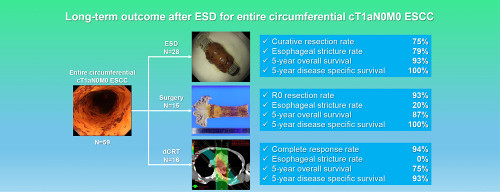
Graphical abstract
Read the full article online.
The information presented in Endoscopedia reflects the opinions of the authors and does not represent the position of the American Society for Gastrointestinal Endoscopy (ASGE). ASGE expressly disclaims any warranties or guarantees, expressed or implied, and is not liable for damages of any kind in connection with the material, information, or procedures set forth.

