
Post written by Tessa Herman, MD, from the Department of Gastroenterology, Hepatology, and Nutrition, Vanderbilt University Medical Center, Nashville, Tennessee, and Daniela Guerrero Vinsard, MD, from the Gastroenterology Section, Minneapolis Veteran Affairs Medical Center, and Department of Medicine, University of Minnesota, Minneapolis, Minnesota, USA.

This nationwide survey study assessed gastroenterology (GE) fellows’ exposure to and experience with artificial intelligence (AI) for polyp detection during colonoscopy, their perceptions on its impact on colonoscopy quality, and their attitudes toward integrating AI into fellowship training. Ultimately, we hope this research informs real hands-on interactions that GE fellows in the United States are experiencing with computer-aided detection and creates momentum for further high-quality research exploring the effects of training fellows with AI for polyp detection as well as ideal time for implementation into endoscopic training.

AI-assisted colonoscopy for polyp detection is becoming increasingly adopted in GE practices for its potential to improve colonoscopy quality. Although prior survey-based studies explored practicing gastroenterologists’ perceptions of AI, little was known about the trainee experience, particularly among fellows with hands-on exposure with the technology. Trainees are key stakeholders in the adoption of emerging technologies, as their experiences during training often influence future practice patterns.
At the same time, important questions remain regarding the optimal timing of AI implementation during fellowship and whether over-reliance on AI could contribute to deskilling or hindering development of polyp detection skills. Understanding fellows’ perspectives is an important first step toward developing a thoughtful educational curriculum.
To our knowledge, our study provides one of the first nationwide assessments of GE fellows’ real-world exposure to AI for polyp detection. We found that many fellows already have access to computer-aided detection during training and are supportive of its incorporation into fellowship. Many fellows favored its implementation during second year after foundational endoscopic skills have been established. Interestingly, a pragmatic study from UCLA showed that AI-assisted colonoscopy significantly improves right-sided adenoma detection for GE trainees without adding procedure time, particularly in first- and second-year fellows performing screening colonoscopies.1
In our survey study, fellows believed that AI offers some benefits such as improved polyp detection and colonoscopy quality but also felt it carries negatives such as over-reliance and deskilling concerns as well as longer withdrawal times. In addition, we found that most fellows do not receive AI-focused education before implementing it into their clinical practice. Future studies should continue to objectively evaluate how AI influences development of cognitive and technical endoscopic skills.
As AI becomes increasingly embedded in everyday endoscopic practice, training programs have the opportunity to proactively prepare the next generation of endoscopists. We hope this study serves as a foundation for future educational research in developing evidence-based curricula on AI.
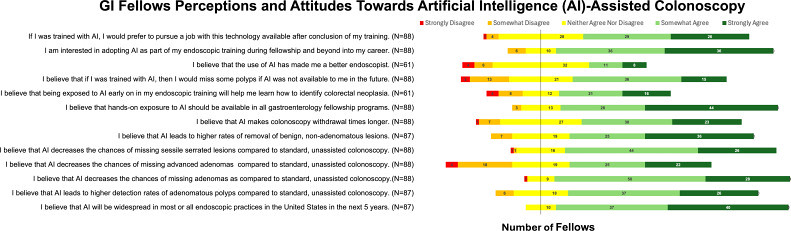
Gastroenterology (GE) fellows’ perceptions and attitudes toward artificial intelligence (AI)-assisted colonoscopy: survey study participants’ responses to statements regarding their perceptions and attitudes toward AI-assisted colonoscopy.
Visit iGIE’s Facebook, X/Twitter, LinkedIn, Instagram, and YouTube accounts for more content from the ASGE peer-reviewed journal that launched in December 2022 and has been PubMed indexed.
Read the full article online.
The information presented in Endoscopedia reflects the opinions of the authors and does not represent the position of the American Society for Gastrointestinal Endoscopy (ASGE). ASGE expressly disclaims any warranties or guarantees, expressed or implied, and is not liable for damages of any kind in connection with the material, information, or procedures set forth.
- Chang PW, Nguyen DD, Kong N, et al. Impact of artificial intelligence–assisted colonoscopy on gastroenterology fellow performance: a pragmatic randomized controlled trial. Gastrointest Endosc 2026;103:1043-51.e3. ↩︎

