
Post written by Rohit Goyal, MBBS, and Prasad Iyer, MD, MS, from the Division of Gastroenterology and Hepatology, Mayo Clinic, Phoenix, Arizona, USA.

Radiofrequency ablation (RFA) is the cornerstone of endoscopic eradication therapy for dysplastic Barrett’s esophagus. Evidence suggests that patients receiving endoscopic eradication therapy at high-volume centers have better outcomes in terms of rates of achieving complete remission of intestinal metaplasia and rates of recurrences. With technology spreading beyond the quaternary referral centers, more patients are now receiving their initial RFA treatment in outside expert centers, and there are few data on what happens to patients who failed this initial therapy.

With this study, we tried to answer 2 questions: time trend in the proportion of patients referred to our expert center after an unsuccessful course of initial RFA outside expert centers, and how do those patients ultimately compare with patients who present to us de novo, without any prior treatment, in terms of treatment required and eventual complete remission of intestinal metaplasia.
Among the 794 patients included in our analysis, 58 patients (7.3%) received RFA treatment prior to referral to our center. We observed a statistically significant upward trend with the odds of 24% each year for the patients who had received RFA prior to referral to our center.
Reassuringly, once these patients underwent comprehensive reassessment, particularly optimization of acid reflux control (needed in nearly two-thirds of 58 patients) and higher need for adjunctive therapies (including endoscopic resection and cryotherapy), their chance of ultimately achieving complete remission of intestinal metaplasia was statistically comparable with patients treated de novo. Our findings suggest that a “failed” RFA course outside expert centers is often not truly refractory disease but rather might be a gap in reflux management or access to adjunctive tools.
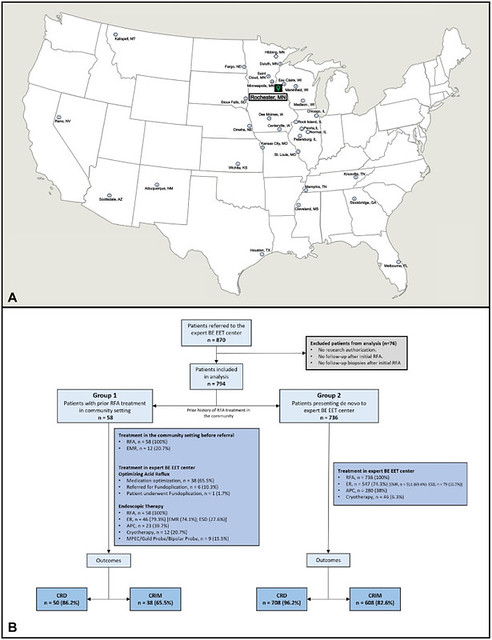
A, Map showing the geographic distribution of referral centers where patients received EET before referral to our center, along with the number of patients referred from each city. B, Flow sheet summarizing evaluation and management of patients treated with EET before and after referral to Mayo Clinic. APC, Argon plasma coagulation; BE, Barrett’s esophagus; CRD, complete remission of dysplasia; CRIM, complete remission of intestinal metaplasia; EET, endoscopic eradication therapy; ER, endoscopic resection; ESD, endoscopic submucosal dissection; MPEC, multipolar electrocoagulation; RFA, radiofrequency ablation.
Read the full article online.
The information presented in Endoscopedia reflects the opinions of the authors and does not represent the position of the American Society for Gastrointestinal Endoscopy (ASGE). ASGE expressly disclaims any warranties or guarantees, expressed or implied, and is not liable for damages of any kind in connection with the material, information, or procedures set forth.

