
Post written by Giuseppe Vanella, MD, PhD, from the Pancreatobiliary Endoscopy and Endosonography Division, IRCCS San Raffaele Scientific Institute, and Vita-Salute San Raffaele University, Milan, Italy.

EUS-guided gastroenterostomy (EUS-GE) is to date a well-established option for malignant gastric outlet obstruction, and the short-term data are strongly supported by recent randomized evidence. What is usually missing is the long view: what actually happens in the long term.
We prospectively followed 166 consecutive patients treated at our center over 4 years. Rather than relying only on symptoms, we also went back and looked at the stent itself—endoscopically and radiologically—whenever we had a clinical opportunity to do so, independent of whether the patient was complaining of anything.
Two trends pushed us here. Patients with cancer are living longer, so a stent that historically only had to survive a few months is now often asked to last years. At the same time, EUS-GE is increasingly used for benign indications, where it may need to stay in place indefinitely. We had almost no real data on how a lumen-apposing metal stent (LAMS) behaves over that kind of timeframe; existing series were mostly retrospective, mixed different indications together, and defined “dysfunction” by symptoms alone, which we suspected was missing a fair amount.
The reassuring finding first: clinically overt dysfunction was uncommon (8.4%), and every single reintervention worked. Given the median time to dysfunction of 209 days and the median overall survival of about 129 days in our cohort, that is a reasonable argument against scheduled surveillance in malignant disease. The more interesting finding arrived from looking past the symptoms. In patients who received endoscopy for other reasons, close to one-half showed some endoscopic change: tissue erosion or overgrowth around the stent in about 40%, and true stent ingrowth in roughly 1 in 5, most of it completely silent.
On CT, the stent diameter shrank in a remarkably linear fashion, about 0.2 mm every month, and a diameter under 16 mm flagged patients at risk of recurrence. So, the LAMS seems to have a fairly predictable life cycle, even when nothing feels wrong to the patient.
Worth noting: these morphologic data resulted almost entirely as a byproduct of endoscopies and CT scans performed for other clinical reasons, mostly biliary drainage and oncological follow-up. We did not add extra procedures purely for surveillance.
For us, the take home message was that clinical durability and structural stability are not the same thing, and to date we are probably underestimating the silent change of LAMSs.
EUS-GE appears highly durable in malignant obstruction, but long-term stent behavior may become increasingly relevant as indications expand and patient survival improves. What should come next is identifying risk factors (even modifiable?) for that ingrowth and erosion process and testing whether a scheduled revision with eventual LAMS exchange makes sense for patients who need the stent to last, particularly in benign disease.
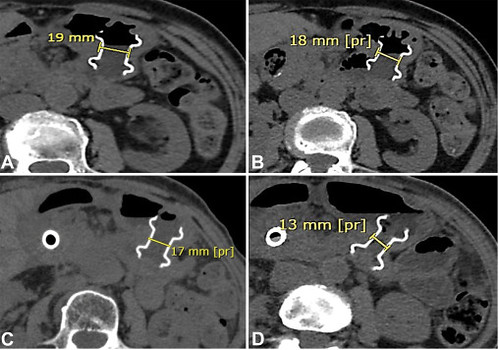
Changes in lumen-apposing metal stent diameter over time. CT scans from the same patient were performed for oncological follow-up. A, Six months after placement. B, Thirteen months after placement. C, Sixteen months after placement. D, Twenty months after placement. pr, Projectional radiography.
Read the full article online.
The information presented in Endoscopedia reflects the opinions of the authors and does not represent the position of the American Society for Gastrointestinal Endoscopy (ASGE). ASGE expressly disclaims any warranties or guarantees, expressed or implied, and is not liable for damages of any kind in connection with the material, information, or procedures set forth.

