
Post written by Hiroshi Yamazaki, MD, and Ken Ohata, MD, PhD, from the Department of Gastrointestinal Endoscopy, NTT Medical Center Tokyo, Tokyo, Japan.

This video demonstrates endoscopic en bloc resection of a large colorectal lipoma by endoscopic submucosal dissection (ESD), facilitated by multiple traction bands. Unroofing was initially attempted on a 70-mm lipoma, but due to its size and the poor electrical conductivity of the fat tissue, only piecemeal resection of the overlying mucosa was possible.
A 50-mm lesion remained at follow-up, and ESD was performed. Two elastic traction bands initially lifted the lesion away from the muscle layer, but as the dissection proceeded, the mass collapsed onto the dissection plane. Additional clip bands were applied sequentially to keep the lipoma lifted off the muscularis propria and to maintain a clear view, allowing safe and effective dissection.

Large colorectal lipomas have traditionally been managed surgically. Endoscopic techniques have evolved, and several methods are now available, but some remain inadequate for larger lesions.
Although ESD allows complete resection of the lipoma and reduces risk of recurrence, the procedure does become more difficult as the lesion increases in size. It is understandable for proceduralists to avoid ESD considering its benign nature and the risk of adverse events.
However, we would like to emphasize the benefit of an organ-preserving procedure over surgery, and the risk of intussusception following incomplete treatment, which may lead to emergency colectomy. We wanted to show that a giant lipoma can be removed en bloc, safely and with organ preservation, using ESD with nothing more than clips and traction bands that are already available in most endoscopy units worldwide.
The main message is that traction is not a single maneuver, but a strategy tailored to the lesion and to the progress of the procedure. Initially, 2 bands are sufficient to lift and stabilize the lipoma to make a good flap. As the dissection proceeds and the mass itself collapses into the dissection plane, the video shows how additional band traction can restore a clear view. By repeating the same process with the right timing, ESD of a large lesion can be reduced to straightforward dissection along a widely open plane.
We hope this video encourages endoscopists to consider endoscopic resection for lesions that might otherwise be referred for surgery.
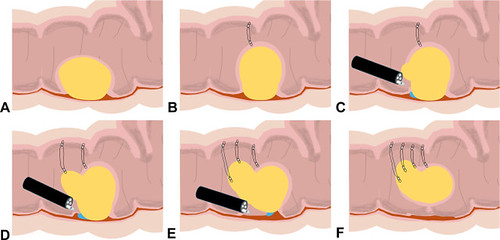
Schema of the multiple traction–assisted colorectal endoscopic submucosal dissection. A, The lipoma is embedded in the submucosal layer. B, Initial traction is applied to lift the lipoma. C, Incision and dissection are initiated from the proximal side. D and E, Additional tractions are applied appropriately to maintain clear view of the dissection plane. F, The lipoma is resected en bloc.
Read the full article online.
The information presented in Endoscopedia reflects the opinions of the authors and does not represent the position of the American Society for Gastrointestinal Endoscopy (ASGE). ASGE expressly disclaims any warranties or guarantees, expressed or implied, and is not liable for damages of any kind in connection with the material, information, or procedures set forth.

