
Post written by GIE Senior Associate Editor David L. Diehl, MD, FACP, MASGE, AGAF, from the Department of Gastroenterology, Hepatology, and Nutrition, Geisinger Medical Center, Danville, Pennsylvania, USA.

This month’s GIE includes a Top Tips that I wrote on the use of cryoballoon ablation (CbA) in the GI tract. In this article, I summarize current applications of CbA, particularly highlighting its use in Barrett’s esophagus (BE) but also uses elsewhere in the GI tract.
Cryoablation has a long history of use in medicine, including GI endoscopy. Liquid nitrogen cryospray has been available for several years and has proven efficacy mainly for treatment of BE and for tumor cryoablation. CbA has an advantage over cryospray of not needing a decompression tube, making the procedure quicker.
There is evidence that CbA causes less postprocedural pain than radiofrequency ablation (RFA) for BE, and CbA has an important role in the treatment of RFA-refractory BE. Postablation esophageal stricture rates are similar to those of RFA, and I include some important points in the Top Tips on how to avoid strictures.
Esophageal tumor ablation also can be accomplished with CbA, although a current limitation is that it can be difficult to position the balloon in cases of tight malignant esophageal strictures. It is expected that the company (Merit Medical Systems, South Jordan, Utah, USA) will develop a cryoballoon specially designed for malignant strictures. In addition, there is a role of CbA for gastric antral vascular ectasia, radiation proctopathy, and even for small duodenal adenomas, all covered in my Top Tips.
Another advantage of CbA is that an expensive purchase of capital equipment is not required. As data accumulate on the efficacy of CbA in the GI tract, increased use by interventional physicians will undoubtedly occur. It is my goal for this Top Tips to be a useful introduction for the use of CbA that can be referred to by the growing number of therapeutic endoscopists.
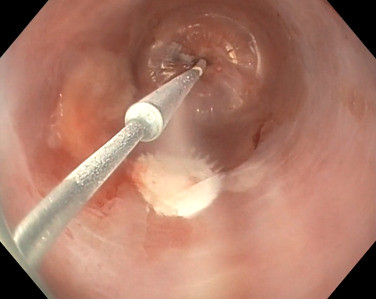
Focal spray at squamocolumnar junction during cryoballoon ablation for Barrett’s esophagus.
Read the full article online.
The information presented in Endoscopedia reflects the opinions of the authors and does not represent the position of the American Society for Gastrointestinal Endoscopy (ASGE). ASGE expressly disclaims any warranties or guarantees, expressed or implied, and is not liable for damages of any kind in connection with the material, information, or procedures set forth.

