
Post written by Carlos Robles-Medranda, MD, FASGE, AGAF, from the Instituto Ecuatoriano de Enfermedades Digestivas and Endoscopy Net, Guayaquil, Ecuador.

This video presents our early clinical experience with the EndoSound Vision System (Portland, Ore, USA), a compact, portable, disposable EUS probe that clips onto a flexible upper GI endoscope while preserving the working channel. We demonstrate device preparation, probe attachment, image acquisition, and comparison with conventional EUS imaging.
The video then illustrates 3 clinical applications: EUS-guided choledochoduodenostomy after failed ERCP in a 63-year-old man with jaundice and biliary obstruction related to a pancreatic head lesion; Doppler characterization of a 3-cm gastric subepithelial lesion in a 72-year-old man; and forward-viewing EUS assessment of an upper GI lesion.
EUS is one of the most powerful tools in therapeutic endoscopy, but its global adoption remains limited by cost, platform complexity, reprocessing requirements, and concerns about infection control. To our knowledge, this video is among the earliest practical demonstrations of how a disposable, attachable EUS probe may broaden access to high-demand diagnostic and therapeutic EUS procedures while potentially reducing cross-contamination risk and preserving endoscopic functionality.
The key lesson is that image-guided endoscopy may evolve beyond the traditional echoendoscope platform. Endoscopists can observe how the disposable EUS probe is mounted, how the working channel remains available, and how a forward-viewing configuration can support both diagnostic and therapeutic decision-making. The cases also highlight the importance of careful patient selection, familiarity with the device’s orientation, awareness of limitations in duodenal access and angulation, and the need for dedicated training before broader implementation.
This technology should be viewed as a complementary platform rather than a replacement for conventional EUS. Its potential value is greatest in settings where access, portability, disposability, and workflow flexibility are clinically meaningful. Further prospective studies are needed to evaluate safety, efficacy, learning curve, durability of image quality, and cost-effectiveness in larger patient populations. Nevertheless, this experience suggests that disposable EUS platforms may help expand the reach of advanced endoscopy.
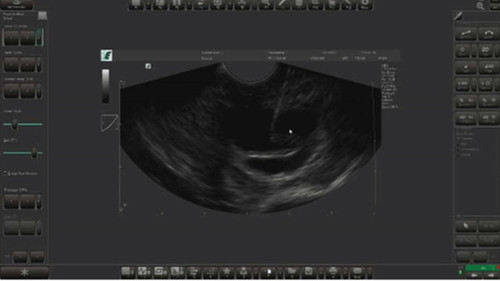
Disposable EUS-guided puncture of the dilated common bile duct using a modified 22-gauge needle and the EndoSound Vision System (Portland, Ore, USA) user interface.
Read the full article online.
The information presented in Endoscopedia reflects the opinions of the authors and does not represent the position of the American Society for Gastrointestinal Endoscopy (ASGE). ASGE expressly disclaims any warranties or guarantees, expressed or implied, and is not liable for damages of any kind in connection with the material, information, or procedures set forth.

