
Post written by Edoardo Vincenzo Savarino, MD, PhD, from the Gastroenterology Unit, Department of Surgery, Oncology and Gastroenterology, University of Padova, Padova, Italy, Mohammad Al Hayek, MD, from the Faculty of Medicine, Damascus University, Damascus, Syrian Arab Republic, and Brigida Barberio, MD, PhD, from the Gastroenterology Unit, Department of Surgery, Oncology and Gastroenterology, University of Padova.

Upper GI cancers remain a major cause of cancer-related mortality worldwide, largely because many lesions are still detected at advanced stages. Our study evaluated whether artificial intelligence (AI)-assisted upper GI endoscopy improves detection of neoplastic lesions compared with conventional endoscopy. We conducted a systematic review and meta-analysis of randomized controlled trials assessing AI-assisted EGD in real-world clinical practice.
Although AI has rapidly entered the field of GI endoscopy, evidence regarding its true clinical benefit during upper GI examinations remained fragmented. Several randomized trials suggested improved lesion detection, but the overall magnitude and consistency of this benefit had not been comprehensively evaluated, to our knowledge. We felt that a rigorous synthesis of the available evidence was needed to better understand the role of AI in improving the quality of upper GI cancer screening and surveillance.
Our meta-analysis included 11 randomized controlled trials involving more than 57,000 patients. We found that AI-assisted endoscopy significantly improved detection of upper GI neoplasms compared with conventional endoscopy on a per-patient and a per-lesion basis. The benefit was particularly evident for small lesions (≤10 mm), which are often the most challenging to identify during routine examinations. AI also improved detection of low- and high-grade intraepithelial neoplasia as well as carcinoma while reducing blind spots without increasing inspection time or biopsy rates.
These findings support the growing role of AI as a quality-enhancing tool during upper GI endoscopy. Future studies should evaluate performance of different AI platforms across diverse health care settings and determine how AI can best support endoscopists with varying levels of experience.
AI is unlikely to replace the endoscopist, but it has the potential to serve as a valuable second observer that enhances mucosal inspection and promotes earlier detection of clinically significant lesions.
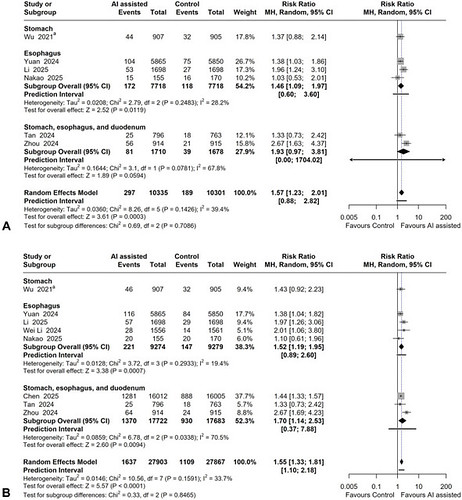
A, Neoplasm detection rate per patient. B, Neoplasm detection rate per lesion. aWu et al, 2021.1 AI, Artificial intelligence; df, degrees of freedom; MH, Mantel–Haenszel method.
Read the full article online.
The information presented in Endoscopedia reflects the opinions of the authors and does not represent the position of the American Society for Gastrointestinal Endoscopy (ASGE). ASGE expressly disclaims any warranties or guarantees, expressed or implied, and is not liable for damages of any kind in connection with the material, information, or procedures set forth.
- Wu L, Shang R, Sharma P, et al. Effect of a deep learning-based system on the miss rate of gastric neoplasms during upper gastrointestinal endoscopy: a single-centre, tandem, randomised controlled trial. Lancet Gastroenterol Hepatol 2021;6:700-8. ↩︎

