
Post written by Aamir Saeed, MD, from the University of Tennessee Health Sciences Center, Memphis, Tennessee, Faisal Kamal, MD, from the Division of Gastroenterology, Thomas Jefferson University Hospital, Philadelphia, Pennsylvania, Mark Radlinski, MD, from the Division of Gastroenterology, Vanderbilt University Medical Center, Nashville, Tennessee, and Sultan Mahmood, MD, from the Division of Gastroenterology, University of Pittsburgh Medical Center, Pittsburgh, Pennsylvania, USA.

We aimed to assess the safety and efficacy of same-day discharge (SDD) after gastric peroral endoscopic myotomy (G-POEM) for gastroparesis.
In this meta-analysis, we evaluated the readmission rate, emergency department (ED) visits, and procedure-related adverse events between SDD versus overnight admission for observation after G-POEM.
Postoperative care after G-POEM in refractory gastroparesis lacks standardization. G-POEM has emerged in recent years as a minimally invasive endoscopic treatment option for gastroparesis, demonstrating clinical success rates ranging from 70% to 90%. However, currently, no standardized postprocedural care protocol exists.
Typically, patients are admitted overnight for observation to monitor for procedure-related adverse events and to manage pain. Most centers also perform a routine postoperative upper GI series to assess for potential leaks. Recently, studies have reported the safety of SDD after G-POEM in patients with gastroparesis.
Six retrospective studies (3 full-length and 3 abstracts) with a total of 738 patients (255 SDD, 483 admitted) were included in the final analysis. There was no significant difference in readmission rate (risk ratio [RR], 0.93; 95% CI, 0.29-3.00), ED visits (RR, 0.88; 95% CI, 0.09-8.52), and procedure-related adverse events (RR, 0.53; 95% CI, 0.17-1.65) between the SDD and overnight admission groups. Procedure time was significantly shorter in the SDD group (mean difference, −9.61; 95% CI, −14.57 to −4.66).
This meta-analysis demonstrates that SDD after G-POEM achieves similar 30-day rates of readmission, ED visits, and procedure-related adverse events compared with overnight admission and is associated with shorter procedure time. Further large studies are needed to validate these results and to facilitate development of standardized protocols for managing patients after G-POEM.
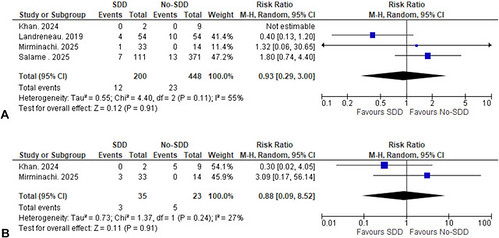
Comparison of readmissions (A) and ED visits (B) between groups. ED, Emergency department; SDD, same-day discharge.
Read the full article online.
The information presented in Endoscopedia reflects the opinions of the authors and does not represent the position of the American Society for Gastrointestinal Endoscopy (ASGE). ASGE expressly disclaims any warranties or guarantees, expressed or implied, and is not liable for damages of any kind in connection with the material, information, or procedures set forth.

