
Post written by Sanjeevani Tomar, MD, from the Division of Gastroenterology and Hepatology, AdventHealth, Abdullah Abbasi, MD, from the Division of Gastroenterology and Hepatology, University of Iowa, Iowa City, Iowa, and Center for Interventional Endoscopy, AdventHealth, Saurabh Chandan, MD, from Advanced Endoscopy, Houston Methodist West Hospital, Houston, Texas, and Center for Interventional Endoscopy, AdventHealth, and Mustafa A. Arain, MD, from the Center for Interventional Endoscopy, AdventHealth, Orlando, Florida, USA.

We present 2 cases of recurrent parastomal variceal bleeding in patients with portal hypertension and complex oncologic histories. Both patients had failed or were not ideal candidates for conventional therapies such as surgical revision or interventional radiology-guided embolization.

Using EUS, we identified the feeder vessels supplying the varices. A 19-gauge needle was used to deploy intravascular coils followed by injection of human thrombin/fibrinogen. Doppler imaging confirmed near-complete obliteration of flow in both cases. One patient achieved durable hemostasis, and the second required repeat intervention with cyanoacrylate glue because of recurrence.

Parastomal varices are an uncommon but potentially life-threatening cause of bleeding, and management can be challenging because of altered anatomy and limited therapeutic options. This video highlights a minimally invasive EUS-guided approach that allows direct targeting of the variceal inflow. To our knowledge, this represents one of the first reports from a U.S. center demonstrating the feasibility of combining coil embolization with thrombin/fibrinogen injection for this indication.
This experience underscores several technical and clinical considerations. First, EUS enables precise localization and treatment of feeder vessels, critical for effective hemostasis. Second, coil embolization alone may be insufficient; adjunctive thrombin/fibrinogen enhances thrombosis and improves outcomes.
Third, careful coil sizing (1.25-1.5 times vessel diameter) and maintaining scope stability are essential to minimize adverse events. Finally, thrombin/fibrinogen may offer a safer alternative to cyanoacrylate glue as an initial therapy, with glue reserved for refractory cases.
EUS-guided therapy represents a promising addition to the armamentarium for managing ectopic varices, particularly in patients with limited options. Larger studies are needed to evaluate long-term efficacy and identify predictors of durable response.
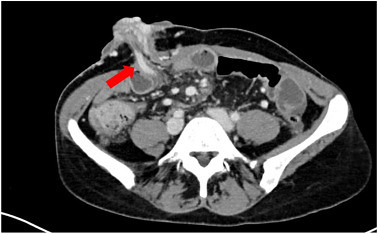
Contrast-enhanced computed tomography image from case 1 demonstrating extensive parastomal varices surrounding the ileostomy site (arrow). Prominent collateral vessels are seen extending from the mesenteric venous circulation to the stoma tract, consistent with portal hypertension–related stomal varices.
Read the full article online.
The information presented in Endoscopedia reflects the opinions of the authors and does not represent the position of the American Society for Gastrointestinal Endoscopy (ASGE). ASGE expressly disclaims any warranties or guarantees, expressed or implied, and is not liable for damages of any kind in connection with the material, information, or procedures set forth.

