Post written by Il Sang Shin, MD, PhD, Jong Ho Moon, MD, PhD, FASGE, FJGES, FACG, Yun Nah Lee, MD, PhD, and Jae Woo Park, MD, from the Digestive Disease Center, Department of Internal Medicine, SoonChunHyang University College of Medicine, Bucheon, South Korea.

We evaluated the feasibility and safety of EUS-guided gallbladder drainage (EUS-GBD) using electrocautery-enhanced lumen-apposing metal stents (EC-LAMSs) in high-risk surgical patients with moderate-to-severe acute cholecystitis (AC) complicated by Niemeier type II gallbladder perforation. Although EUS-GBD can serve as an effective alternative for gallbladder decompression in poor surgical candidates, gallbladder perforation has been considered a contraindication because of the potential risk of bile peritonitis.
However, given that AC complicated with Niemeier type II perforation represents a walled-off compartment, EUS-GBD may be a feasible option in these patients. Therefore, we aimed to investigate whether EUS-GBD could be safely performed in selected patients with Niemeier type II perforation.
After we excluded 5 patients who underwent alternative interventions, 14 patients underwent EUS-GBD using EC-LAMSs. Technical success was achieved in all patients (14/14, 100%), and clinical success was observed in 92.9% (13/14). The median procedure time was 13.3 minutes. During a median follow-up period of 314.5 days, overall adverse events occurred in 35.7% of patients (5/14), with no severe or fatal adverse events. Our preliminary data suggest that Niemeier type II perforation with an adjacent encapsulated collection may not represent an absolute contraindication to EUS-GBD in patients with AC.
Further comparative studies are warranted to evaluate the clinical use and outcomes of EUS-GBD in patients with Niemeier type II gallbladder perforation, including comparisons with alternative approaches such as percutaneous drainage and assessments of differences among EC-LAMS devices. Such studies may provide further evidence to support the potential expansion of indications for EUS-GBD.
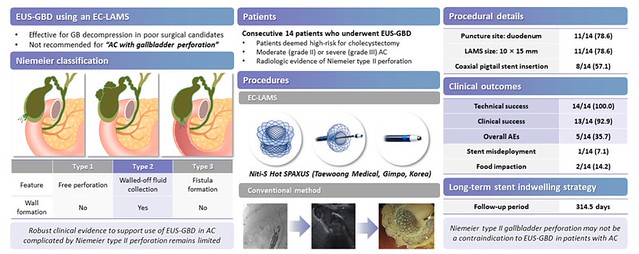
Graphical abstract
Read the full article online.
The information presented in Endoscopedia reflects the opinions of the authors and does not represent the position of the American Society for Gastrointestinal Endoscopy (ASGE). ASGE expressly disclaims any warranties or guarantees, expressed or implied, and is not liable for damages of any kind in connection with the material, information, or procedures set forth.

