
Post written by Dimo Dimitrov, MD, from the Department of Medicine, Boston Medical Center-Brighton, Boston, Massachusetts, USA.

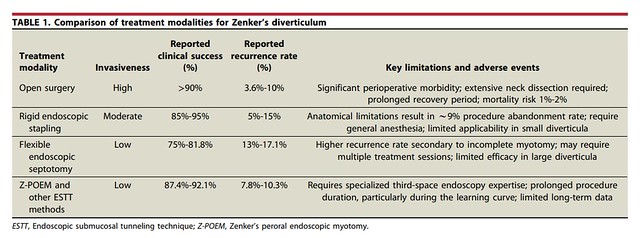
In this Topic Review, we examine how treatment of Zenker’s diverticulum has evolved from open surgery and rigid endoscopic approaches to flexible endoscopic septotomy and third-space techniques, particularly Zenker’s peroral endoscopic myotomy (Z-POEM). We also review newer cutting devices and provide a practical framework for preventing, recognizing, and managing adverse events.
Zenker’s diverticulum can substantially impair quality of life through dysphagia, regurgitation, aspiration, and weight loss, particularly in older adults. Although minimally invasive endoscopic therapy has transformed treatment, techniques and devices are evolving rapidly, and the literature on adverse event management remains dispersed. We felt it was important to bring these developments together in a clinically practical review because rare adverse events can become serious when not recognized and treated promptly.
Our review highlights that Z-POEM and related third-space approaches achieve high technical and clinical success while allowing a more complete myotomy under direct visualization. Scissor-type knives may offer greater control by allowing tissue to be grasped, coagulated, and then divided, which can be especially useful in confined or fibrotic anatomy. At the same time, no single technique is appropriate for every patient or endoscopist; anatomy, prior interventions, operator experience, and local resources should guide treatment selection.
We also summarize stepwise management of bleeding, perforation or leakage, mediastinitis, subcutaneous emphysema, pneumomediastinum, and aspiration. The central message is that excellent outcomes depend not only on technical innovation but also on careful case selection, secure closure, airway protection, early recognition of concerning symptoms, and access to a multidisciplinary team and rescue strategies.
The next phase of the field should include prospective multicenter comparisons of modern flexible septotomy and Z-POEM, standardized procedural and adverse event protocols, structured competency pathways, and greater emphasis on durability, quality of life, nutritional recovery, and cost-effectiveness.
For clinicians adopting these techniques, innovation should be paired with preparedness. The safest advanced endoscopist is not only able to perform the procedure but is also ready to recognize and manage its adverse events.
Visit iGIE’s Facebook, X/Twitter, LinkedIn, Instagram, and YouTube accounts for more content from the ASGE peer-reviewed journal that launched in December 2022 and has been PubMed indexed.
Read the full article online.
The information presented in Endoscopedia reflects the opinions of the authors and does not represent the position of the American Society for Gastrointestinal Endoscopy (ASGE). ASGE expressly disclaims any warranties or guarantees, expressed or implied, and is not liable for damages of any kind in connection with the material, information, or procedures set forth.

