
Post written by Sandro Sferrazza, MD, and Giulio Calabrese, MD, from the Gastroenterology and Endoscopy Unit, ARNAS Civico-Di Cristina-Benfratelli, Palermo, Italy.

Our study evaluated incidence, predictors, clinical consequences, and management of postresection stenosis after endoscopic submucosal dissection (ESD) for colorectal lesions involving ≥90% of the luminal circumference. We conducted an international multicenter analysis including 315 patients treated at 29 tertiary referral centers, also assessing efficacy and safety of ESD in this particularly challenging setting.
Circumferential and near-circumferential colorectal lesions are uncommon but among the most technically demanding lesions treated by ESD. Previous evidence was limited mainly to relatively small, single-center Asian series, predominantly involving rectal lesions, and data on complete circumferential resections and colonic lesions remained scarce. Consequently, the actual risk of stenosis, its predictors, and its clinical manageability in contemporary Western and international practice were poorly defined.
Stenosis developed in 34.2% of evaluable patients and was substantially more frequent after rectal than colonic ESD (38.2% vs 11.6%). Rectal location, complete 100% circumferential resection, and increasing lesion size were independently associated with stenosis. Importantly, all treated stenoses were successfully managed endoscopically, predominantly with balloon or bougie dilation, without the need for surgery. Despite the complexity of these lesions, ESD achieved en bloc, R0, and curative resection rates of 85.1%, 81.8%, and 80.3%, respectively.
These findings support ESD as a feasible organ-preserving approach, even for extremely extensive colorectal lesions, while highlighting the importance of preserving a strip of healthy mucosa whenever technically and oncologically appropriate. Future prospective studies should determine the optimal strategy for stenosis prevention and evaluate long-term functional outcomes and quality of life.
To our knowledge, this represents the first large international multicenter study specifically addressing ESD of colorectal lesions involving ≥90% of the circumference and provides clinically relevant data for counseling patients, planning resection strategies, and anticipating postprocedural management.
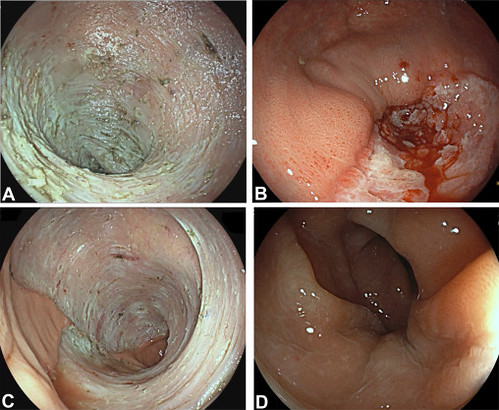
Postendoscopic submucosal dissection (ESD) resection bases in 2 circumferential rectal lesions. A, 100% circumferential resection base with (B), stricture development at follow-up. C, 90% to 100% circumferential resection base. D, Without stricture development at follow-up.
Read the full article online.
The information presented in Endoscopedia reflects the opinions of the authors and does not represent the position of the American Society for Gastrointestinal Endoscopy (ASGE). ASGE expressly disclaims any warranties or guarantees, expressed or implied, and is not liable for damages of any kind in connection with the material, information, or procedures set forth.

