
Post written by Miguel Martins, MD, Joana Mota, MD, and Filipe Vilas-Boas, MD, PhD, from the Gastroenterology Department, Centro Hospitalar Universitário São João, and Faculty of Medicine of University of Porto, Porto, Portugal.
A 59-year-old woman receiving chemotherapy for adenocarcinoma of the third duodenal portion developed gastric outlet obstruction from disease progression and underwent EUS-guided gastroenterostomy (EUS-GE). During EUS-GE, an unrecognized transverse colon loop lay between the stomach and target jejunum. The lumen-apposing metal stent (LAMS) transfixed both colonic walls before its distal flange deployed in the jejunum, consistent with the recently described type V misdeployment of Vanella et al.1 The LAMS later migrated into the colon; however, by that time, a mature colojejunal fistula had already formed.
We rescued the anastomosis endoscopically by deploying a 20-mm partially covered tubular metal stent through the LAMS transcolonically into the jejunum. Matching its diameter to the 20-mm LAMS created a tight stent-in-stent seal and preserved a wide lumen. The covered segment helped exclude the colonic lumen, limiting food passage into the colon and fecal reflux into the stomach. The patient resumed a soft diet, was discharged 72 hours later, and remained alive and tolerating oral intake 1 year later.
Ghandour et al2 described 4 classic EUS-GE misdeployment types. Type V differs because it is characterized by transfixation (through-and-through puncture) of a collapsed loop between the stomach and target loop. Retrospective review of the index EUS showed the colon between the stomach and jejunum; this subtle sign was missed while attention focused on the LAMS landing target. Highlighting these markers may help others recognize and avoid colonic interposition.
Moreover, the video demonstrates that this complex adverse event may sometimes be managed endoscopically in a stable patient without peritoneal contamination. Success, however, depended on spontaneous colojejunal fistula maturation and atraumatic scope passage, which may not be reproducible in every case.
For crossable strictures, we use the wireless EUS-GE simplified technique because, to our knowledge, a double-balloon catheter is unavailable in Europe. Regardless of technique, operators should carefully identify an optimal window and inspect the entire puncture path for interposed structures rather than focusing only on the target loop. This case also is worth sharing because, in selected cases, a matching-diameter, partially covered stent-in-stent may seal the tract while preserving luminal patency, avoiding a high-risk surgical revision.
The stent-in-stent rescue approach may be associated with long-term risks that could not be fully addressed in the manuscript because of word limitations. One concern is that shearing forces could cause fracture of the covered metal stent or disruption of its covering. This could permit food to pass into the colon and/or colonic contents to reflux into the stomach, potentially compromising oral intake and causing gastric contamination. We selected a partially covered metal stent to recreate the anastomosis. The uncovered distal jejunal portion was intended to promote tissue ingrowth, improve sealing, and reduce risk of migration.
However, tissue ingrowth also may increase the long-term risk of stent obstruction. Dietary management was therefore important. The patient was advised to maintain a soft diet to reduce the risk of food impaction and luminal occlusion, which may be further promoted by biofilm formation in this setting.
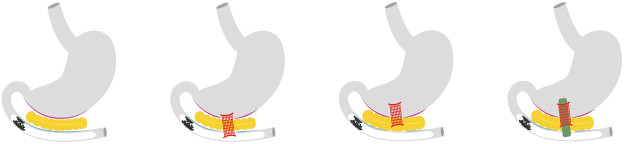
Schematic representation of the initial procedure and its adverse events. A, Gastric outlet obstruction caused by tumor progression, with the transverse colon interposed between the gastric and jejunal walls. B, Misdeployment of the lumen-apposing metal stent, creating an inadvertent gastrocolonic fistula. C and D, Development of a colojejunal fistula, resulting in a continuous tract between the stomach, colon, and jejunum.
Read the full article online.
The information presented in Endoscopedia reflects the opinions of the authors and does not represent the position of the American Society for Gastrointestinal Endoscopy (ASGE). ASGE expressly disclaims any warranties or guarantees, expressed or implied, and is not liable for damages of any kind in connection with the material, information, or procedures set forth.
- Vanella G, Frigo F, Bronswijk M, et al. Standardizing success and troubleshooting in EUS-guided gastroenterostomy: an international technical review (with videos). J Clin Gastroenterol 2026;60:197-215. ↩︎
- Ghandour B, Bejjani M, Irani SS, et al; EUS-GE Study Group. Classification, outcomes, and management of misdeployed stents during EUS-guided gastroenterostomy. Gastrointest Endosc 2022;95:80-9. ↩︎

