
Post written by Ho Seung Lee, MD, Gunn Huh, MD, and Do Hyun Park, MD, PhD, from the Division of Gastroenterology, Department of Internal Medicine, Asan Medical Center, University of Ulsan College of Medicine, and the Department of Internal Medicine, Korea University Anam Hospital, Seoul, South Korea.

This study evaluated the real-world clinical impact of EUS-guided tissue acquisition in patients with suspected primary or recurrent lymphoma. We focused not only on diagnostic performance but also on whether EUS-guided biopsy provided clinically actionable information that could directly influence patient management.
Although excisional biopsy remains the reference standard for lymphoma diagnosis, obtaining tissue from deep-seated abdominal lymph nodes can be challenging. In clinical practice, we increasingly encountered patients with suspected recurrent lymphoma who required tissue confirmation but were poor candidates for surgical biopsy.

Despite growing use of EUS-guided biopsy, data regarding its practical role in both newly suspected and recurrent lymphoma remain limited. We therefore wanted to evaluate how EUS-guided biopsy is being used in contemporary practice and whether it provides sufficient information for clinical decision-making.
EUS-guided biopsy achieved high technical success and a low adverse event rate. Most importantly, it provided actionable diagnostic information in the majority of patients. Among patients with suspected recurrence, EUS-guided biopsy frequently confirmed relapse while also reliably excluding recurrent lymphoma in others.

One particularly interesting finding was the evolving role of EUS-guided biopsy over time. During the early years of our study, procedures were primarily performed for initial diagnosis, whereas suspected recurrence became the predominant indication in recent years.
We believe this trend reflects growing confidence in EUS-guided tissue acquisition as a minimally invasive alternative to surgical biopsy. Future multicenter studies are needed to validate these findings and further define the role of EUS-guided biopsy in management of recurrent lymphoma.
As biopsy needles and tissue acquisition techniques continue to improve, EUS-guided biopsy is becoming increasingly relevant beyond traditional GI indications. We hope our study encourages greater collaboration among endoscopists, hematologists, oncologists, surgeons, and pathologists when evaluating patients with deep-seated lymphadenopathy.
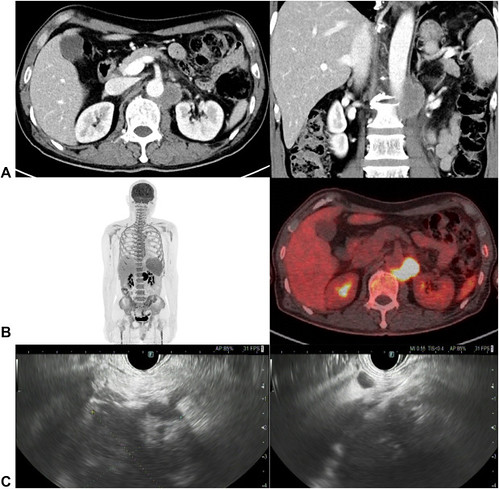
Representative images of target lymph nodes in suspected lymphoma. A, Contrast-enhanced CT showing bulky para-aortic lymphadenopathy. B, Positron emission tomography-CT showing fluorodeoxyglucose-avid mesenteric lymph nodes. C, EUS image of a hypoechoic lymph node during EUS-guided core biopsy using a 22-gauge needle.
Read the full article online.
The information presented in Endoscopedia reflects the opinions of the authors and does not represent the position of the American Society for Gastrointestinal Endoscopy (ASGE). ASGE expressly disclaims any warranties or guarantees, expressed or implied, and is not liable for damages of any kind in connection with the material, information, or procedures set forth.

