
GIE Associate Editor Edward C. Villa, MD, FASGE, FACG, AGAF, highlights this article from the June issue: “Economic impact and utilization trends of peroral endoscopic myotomy and endoscopic submucosal dissection” by Julietta Gervase, BA, et al.

For anyone looking into expanding into “the realm of the third space,” system challenges and waning administrative support and implementation because of cost considerations may dissuade the endoscopist from training in these techniques or offering them to patients. Although the clinical benefits of endoscopic submucosal dissection (ESD) and peroral endoscopic myotomy (POEM) cannot be understated, it is often the financial impediments that limit implementation of these highly complex but historically low-reimbursing approaches.
While on an independent level many endoscopists attempt to justify these procedures within their home institutions—often with limited ability to understand or describe downstream, systemwide impacts apart from the procedures themselves—reliable information has been difficult to produce or find. This study excellently demonstrates preprocedural, procedural, and downstream system economic impact for third-space endoscopic interventions, adding to the endoscopist’s ability to negotiate and navigate the complex financial considerations of patient care.
Gervase and colleagues beautifully delineate the economic impact and reimbursement in this single-center retrospective study of 825 patients who underwent ESD or POEM at a large-volume tertiary center, using their center’s cost-accounting system data from 2018 to 2024. Compilation of charges and corresponding reimbursements generated from preprocedural workup, the procedures, and downstream revenue demonstrated that in spite of low reimbursement percentage rates for procedures (15.5%-22.4%), $73.5M in physician and hospital charges were produced over the 7 years of the study, including a rather impressive $39.9M in downstream charges.
This resulted in a substantial $15.7M of reimbursement. In addition, ESD and POEM drew 349 new patients to the system over the course of the study, with a corresponding $28.5M in charges and $5.8M in reimbursements, further supporting expansion of the referral base, which could be further capitalized with system investment.
Despite ostensibly low direct reimbursement of third-space endoscopic techniques, impressive overall reimbursement (driven in large part by an expanded referral base and downstream reimbursement) can be seen with these procedures, which may be a selling point for system investment in expansion of advanced therapeutic endoscopy programs and third-space endoscopy.
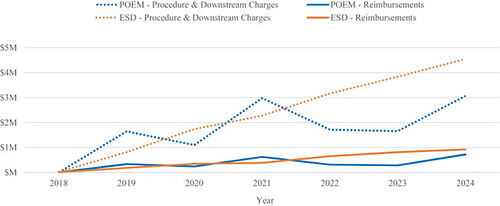
Revenue generated by patients new to health system at the time of procedure. ESD, Endoscopic submucosal dissection; POEM, peroral endoscopic myotomy.
Read the full article online.
The information presented in Endoscopedia reflects the opinions of the authors and does not represent the position of the American Society for Gastrointestinal Endoscopy (ASGE). ASGE expressly disclaims any warranties or guarantees, expressed or implied, and is not liable for damages of any kind in connection with the material, information, or procedures set forth.

