
Post written by Wasseem Skef, MD, from the Center for Interventional Gastroenterology, The University of Texas Health Science Center at Houston, Houston, Texas, USA.

Prolonged wireless pH monitoring is a cornerstone in the modern diagnostic approach to gastroesophageal reflux disease, particularly in patients with unproven disease. Traditionally, wireless pH capsules are placed during sedated upper endoscopy, which can be resource-intensive and may delay testing in publicly funded health systems.
Our study evaluated the feasibility, safety, and reliability of an alternative approach—unsedated transoral placement of a wireless pH capsule—in a Veterans Affairs hospital population. We compared unsedated transoral placement with standard endoscopic placement, focusing on technical success, adverse events, and study completeness, particularly in the context of prolonged (>48-hour) pH monitoring.
Although prior studies have demonstrated that unsedated transoral wireless pH capsule placement can be safe and well tolerated, most were limited to shorter, 48-hour monitoring periods and conducted in high-volume referral centers. With updated guidelines increasingly favoring prolonged wireless pH testing, it was important to evaluate whether this approach remains reliable in real-world practice, especially in a Veterans Affairs setting where access to endoscopy may be limited. To our knowledge, limited data existed on the performance of unsedated transoral placement for prolonged monitoring in this population. Understanding its limitations and tradeoffs is essential before adopting it broadly as a resource-sparing alternative.
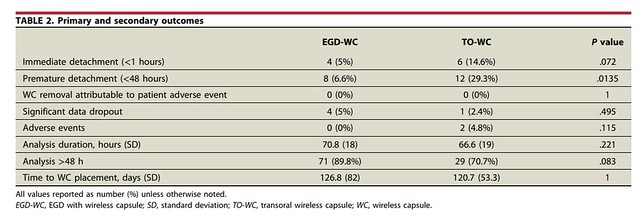
Our study found that unsedated transoral wireless pH capsule placement is feasible and generally safe but may be less reliable than endoscopic placement when prolonged monitoring is desired. As highlighted in the article’s Table 2, transoral placement showed a trend toward lower technical success and a significantly higher rate of premature capsule detachment within 48 hours compared with endoscopic placement. Although pH metrics such as acid exposure time and DeMeester score were similar between groups when studies were successfully completed, a smaller proportion of transoral studies achieved more than 48 hours of analyzable data.
These findings suggest that although the transoral approach can reduce procedural burden and avoid sedation, it may compromise mucosal adherence needed for prolonged studies, particularly during early adoption. Future work should focus on defining training thresholds, refining technique, and identifying patient factors that predict durable capsule attachment. Prospective studies also may clarify whether this approach can be optimized to support longer monitoring durations.
Unsedated transoral wireless pH capsule placement may still have a role in select patients and settings, particularly where endoscopic resources are constrained. However, caution is warranted when prolonged pH monitoring is required.
Visit iGIE’s Facebook, X/Twitter, LinkedIn, Instagram, and YouTube accounts for more content from the ASGE peer-reviewed journal that launched in December 2022 and has been PubMed indexed.
Read the full article online.
The information presented in Endoscopedia reflects the opinions of the authors and does not represent the position of the American Society for Gastrointestinal Endoscopy (ASGE). ASGE expressly disclaims any warranties or guarantees, expressed or implied, and is not liable for damages of any kind in connection with the material, information, or procedures set forth.

