Post written by Akira Dobashi, MD, PhD, from the Department of Endoscopy, The Jikei University Kashiwa Hospital, Kashiwa, Japan.

We present a case of a 65-mm GI stromal tumor located at the esophagogastric junction (EGJ) that was successfully resected en bloc using a combined endoscopic and laparoscopic approach. By integrating laparoscopic and endoscopic cooperative surgery with a submucosal tunneling technique similar to that used in peroral endoscopic myotomy (POEM), we achieved complete tumor resection while preserving the mucosal integrity of the EGJ, despite the large tumor size.
Surgical resection of tumors at the EGJ can be technically challenging because reconstruction of the esophagogastric wall is often complex and time-consuming. Furthermore, extensive resection and subsequent reconstruction may lead to a postoperative stricture or deformity of the EGJ.
Our technique allows the mucosal layer to be preserved while minimizing the extent of esophageal and gastric wall resection. This facilitates laparoscopic suturing and simplifies surgical reconstruction, potentially reducing the risk of a postoperative stricture.
This technique demonstrates how established endoscopic skills, particularly those used with POEM and endoscopic submucosal dissection, can be combined with laparoscopic surgery to treat large tumors at the EGJ. For endoscopists experienced with POEM or endoscopic submucosal dissection, the endoscopic component of this approach may be relatively straightforward to adopt. We believe that this approach may expand minimally invasive treatment options for selected patients with large subepithelial tumors at the EGJ.
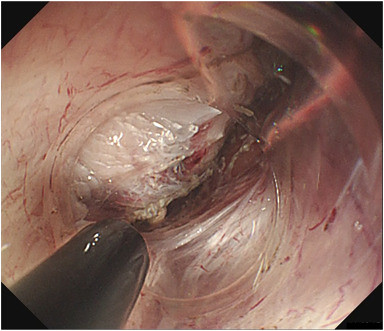
Endoscopic muscular incision at the tumor margin. The tumor was located on the left side of the image, with normal esophageal muscle on the right. The muscular layer between the tumor and normal esophageal muscle was incised using an insulation-tipped diathermic knife.
Read the full article online.
The information presented in Endoscopedia reflects the opinions of the authors and does not represent the position of the American Society for Gastrointestinal Endoscopy (ASGE). ASGE expressly disclaims any warranties or guarantees, expressed or implied, and is not liable for damages of any kind in connection with the material, information, or procedures set forth.

