
Post written by Eric Lam, MD, from the Department of Medicine, University of British Columbia, and Digestive Health Centre, St Paul’s Hospital, Vancouver, British Columbia, Canada, Justin Buttar, MD, from the Department of Medicine, University of British Columbia, and Neal Shahidi, MD, PhD, from the Department of Medicine, University of British Columbia, and St Paul’s Hospital, Digestive Health Centre.

Perforation remains the most-feared endoscopy-related adverse event. Endoscopic closure is now the first-line treatment strategy with expansion of our toolkit including through-the-scope clips (TTSCs), over-the-scope clips (OTSCs), and over-the-scope suturing (OTSS).
Because of the lack of comparative performance between TTSCs, OTSCs, and OTSS, we performed a systematic review and meta-analysis comparing the technical and clinical success of these 3 modalities for iatrogenic perforation, stratified by closure modality, perforation location, perforation etiology (tissue resection-related vs nontissue resection-related), and time.

Among 37 citations encompassing 795 perforations, pooled technical success and clinical success were high at 91.5% and 86.3%, respectively. Clinical success was significantly higher for tissue resection-related perforations and perforations in the stomach with no difference when stratifying by modality (TTSCs, OTSCs, and OTSS) and time.

Our findings support current guidelines recommending endoscopic management of iatrogenic perforations, with no difference among modalities. In our view, a protocolized approach matters as much as the closure device.
This includes readily available equipment within the endoscopy suite with a team trained to use it, carbon dioxide insufflation, patient positioning to avoid defect contamination, confirmation of complete apposition of the defect margins once closure is complete, and empiric antibiotics. This should be coupled with a low threshold for radiologic imaging, hospital admission, and surgical consultation if postprocedural peritonism is present.
Current TTSC outcomes are needed to optimize comparisons with OTSCs, OTSS, and through-the-scope suturing, alongside empowering cost-effectiveness analyses.
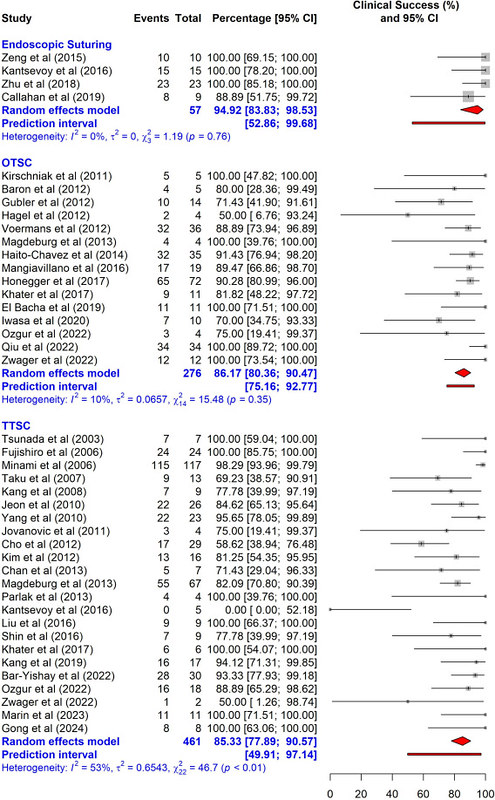
Subgroup analysis of technical success and clinical success stratified by endoscopic modality. CI, Confidence interval; OTSC, over-the-scope clip; TTSC, through-the-scope clip.
Visit iGIE’s Facebook, X/Twitter, LinkedIn, Instagram, and YouTube accounts for more content from the ASGE peer-reviewed journal that launched in December 2022 and has been PubMed indexed.
Read the full article online.
The information presented in Endoscopedia reflects the opinions of the authors and does not represent the position of the American Society for Gastrointestinal Endoscopy (ASGE). ASGE expressly disclaims any warranties or guarantees, expressed or implied, and is not liable for damages of any kind in connection with the material, information, or procedures set forth.

