
Post written by Courtney Svenstrup, MD, and Brett J. Hoskins, DO, from the Division of Pediatric Gastroenterology, Hepatology, and Nutrition, Department of Pediatrics, Riley Hospital for Children at IU Health, Indiana University School of Medicine, Indianapolis, Indiana, USA.

Our case report describes a nonthermal, guidewire-assisted technique for removing an embedded foreign body in a child when conventional retrieval methods failed. A 13-year-old boy swallowed a 6.6-cm metallic carabiner that remained in the upper gastrointestinal tract for 2 weeks. At endoscopy, the spring-loaded gate had trapped a fold of mucosa at the pylorus-duodenal junction and gradually eroded through the tissue, creating a tissue bridge that anchored the object in place.

Embedded foreign bodies pose a particularly difficult challenge in children, where the anatomy is smaller, and forceful extraction may cause injury. In this case, forceps and snares could not release the carabiner. Electrocautery also was concerning because the metal was in direct contact with tissue in the confined pyloric and duodenal region, increasing the risk of thermal injury and potentially full-thickness perforation. We wanted to share a practical, minimally invasive alternative that could avoid intra-abdominal surgery while minimizing the risk of injury.
Working closely with pediatric surgery, we passed a 0.035-inch curved-tip guidewire beneath the mucosal bridge, retrieved its distal end, and formed a loop around the trapped tissue. A vascular introducer sheath protected the esophagus and gastroesophageal junction while controlled, reciprocating tension mechanically divided the bridge in less than 1 minute. The carabiner was removed endoscopically, and the resulting defect was closed with 5 clips. Fluoroscopy showed no leak or perforation, and the patient was discharged the next day.
To our knowledge, this application of mechanical “cheese-wire” transection has not previously been reported for an endoscopically embedded foreign body. Although a single case cannot establish general safety or effectiveness, it highlights how adapting familiar tools can expand options for carefully selected patients. Further experience should clarify appropriate indications, technical safeguards, and outcomes.
The central lesson is not that this technique should replace standard retrieval. Rather, when a foreign body is tethered by tissue, and conventional methods are unsuccessful or unsafe, a carefully planned nonthermal approach may be useful. Precise wire placement, protection of surrounding mucosa, endoscopic defect closure, and close coordination with surgical colleagues, including immediate surgical backup, are essential.
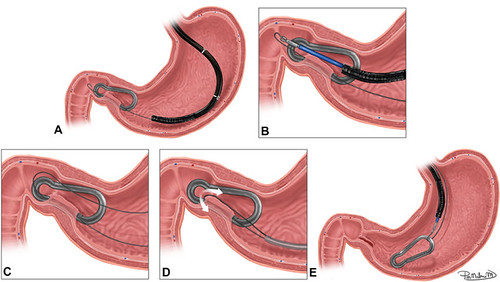
Stepwise schematic of the mechanical (“cheese-wire”) transection technique. A, A 0.035-inch curved-tip guidewire is passed endoscopically beneath the mucosal tissue bridge anchoring the carabiner. B, The endoscope is withdrawn over the wire and reinserted into the duodenum to retrieve the distal end of the wire with forceps. C, The wire is pulled back through the esophagus and out the mouth, creating a loop around the tissue bridge. D, A vascular introducer sheath is advanced over both wire limbs to protect the upper gastrointestinal tract. Controlled reciprocating tension is applied to mechanically transect the tissue bridge. E, The freed carabiner is extracted endoscopically, and the tissue defect is closed with endoscopic clips.
Visit iGIE’s Facebook, X/Twitter, LinkedIn, Instagram, and YouTube accounts for more content from the ASGE peer-reviewed journal that launched in December 2022 and has been PubMed indexed.
Read the full article online.
The information presented in Endoscopedia reflects the opinions of the authors and does not represent the position of the American Society for Gastrointestinal Endoscopy (ASGE). ASGE expressly disclaims any warranties or guarantees, expressed or implied, and is not liable for damages of any kind in connection with the material, information, or procedures set forth.

