
Post written by Henriette Heinrich, MD, from Universitäres Bauchzentrum Clarunis, University of Basel, Basel, Switzerland.

Endoscopic submucosal dissection (ESD) offers organ-preserving treatment for early gastrointestinal neoplasia, but learning this technically demanding technique requires substantial hands-on practice. We evaluated the face validity and short-term training performance of EndoCubot (EndoRobotics, Seoul, South Korea), a mixed-reality simulator combining real endoscopic instruments, artificial layered tissue, and adjustable anatomical positions and movements.
Eight European endoscopists with limited clinical ESD experience completed a structured 2-day course. We assessed their dexterity before and after training using the same 5-minute, 40-point marking-and-incision task, alongside a questionnaire about realism and educational value.
Access to supervised ESD training remains uneven, particularly in Western settings where case volumes and expert mentorship may be limited. Traditional animal-based models also involve ethical, financial, and logistical challenges. We wanted to explore whether a reproducible, animal-free simulator could offer realistic opportunities to practice essential ESD movements, receive feedback, and maintain dexterity without involving patients.
The results were encouraging. Mean dexterity scores increased from 25.50 to 34.75 out of 40 after the course, an improvement of 9.25 points (95% confidence interval, 4.99-13.51; P < .001). Participants also rated the learning environment, technical performance, and clinical realism highly and generally viewed the simulator as a useful addition to patient-based training. Importantly, this was a small uncontrolled pilot involving only 8 trainees.
Better performance on a simulator does not yet demonstrate safer or more effective ESD in patients, nor does it establish long-term skill retention. The next steps are larger comparative studies, evaluation of transfer to clinical procedures, longer-term follow-up, cost-effectiveness analyses, and validated competency benchmarks.
For us, the broader opportunity is to move ESD education beyond counting procedures toward structured practice and measurable skills. Mixed-reality simulation could eventually complement expert supervision and clinical training, while reducing dependence on animal models. It should be regarded as a promising training adjunct rather than a proven substitute for clinical experience.
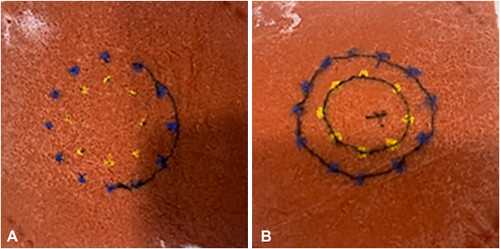
Example of the paired dexterity assessment in the antrum posterior wall position at the start with only about half of the blue dots connected (A) and conclusion of the training with all yellow and blue dots connected correctly (B).
Visit iGIE’s Facebook, X/Twitter, LinkedIn, Instagram, and YouTube accounts for more content from the ASGE peer-reviewed journal that launched in December 2022 and has been PubMed indexed.
Read the full article online.
The information presented in Endoscopedia reflects the opinions of the authors and does not represent the position of the American Society for Gastrointestinal Endoscopy (ASGE). ASGE expressly disclaims any warranties or guarantees, expressed or implied, and is not liable for damages of any kind in connection with the material, information, or procedures set forth.

