
Post written by Theodore W. James, MD, MSc, from St. Joseph Healthcare, University of New England, Bangor, Maine, USA.

This is a unique case regarding a patient with a suspected pheochromocytoma who underwent endoscopic ultrasound (EUS) with fine-needle aspiration (FNA) for diagnosis.
These cases are challenging to manage, as the dogma has always been that needle puncture is ill-advised because it can release a catecholamine surge, which can be catastrophic. The conventional approach is to make a diagnosis based on imaging—but what if the imaging is equivocal? Or if the patient has a history of cancer? Or if the surgeons are planning a specific surgery depending on the pathology?
We held a multidisciplinary meeting to discuss all possible management options and, after receiving support from my anesthesia colleagues regarding perioperative care, we felt that EUS with FNA would be the least-risky approach. The procedure was completed without any issue and, for this reason, it was considered very important to describe our protocol and provide helpful images and video to aid other clinicians in similar diagnostic scenarios.
This study should help reassure endosonographers that with appropriate precautions and good technique, EUS-guided FNA can safely be performed when indicated. Future studies should assess the optimal technique for sampling, as this present case used the least traumatic approach possible and risked undersampling.
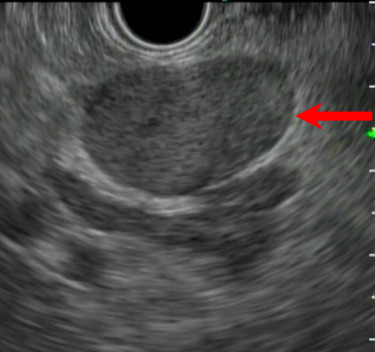
Endoscopic ultrasound image of the left adrenal mass (arrow), demonstrating a 25-mm, well-encapsulated, homogeneous, isoechoic lesion without internal vascularity on Doppler assessment.
Visit iGIE’s Facebook, X/Twitter, LinkedIn, Instagram, and YouTube accounts for more content from the ASGE peer-reviewed journal that launched in December 2022 and has been PubMed indexed.
Read the full article online.
The information presented in Endoscopedia reflects the opinions of the authors and does not represent the position of the American Society for Gastrointestinal Endoscopy (ASGE). ASGE expressly disclaims any warranties or guarantees, expressed or implied, and is not liable for damages of any kind in connection with the material, information, or procedures set forth.

