
Post written by Mina Alkomos, MD, DABOM, from the Gastroenterology Department, Mount Sinai South Nassau, Oceanside, New York, and Walid Baddoura, MD, from the Gastroenterology Department, St Joseph’s University Medical Center, Paterson, New Jersey, USA.

This video demonstrates a simple modification to the delivery system used during application of hemostatic powder to reduce catheter clogging.
Catheter occlusion remains one of the most frustrating technical challenges during hemostatic powder deployment, particularly in the setting of active GI bleeding, where moisture exposure can prematurely activate the powder. We developed a modified set-up using a standard 4-way stopcock (Discofix; B. Braun, Melsungen, Germany) connected to a continuous CO₂ source, allowing uninterrupted gas flow through the catheter (TC-325 Hemospray; Cook Medical, Bloomington, Ind, USA) while maintaining the ability to deliver the powder when needed.
The technique was initially evaluated in a bench-top model and subsequently applied during endoscopic management of an actively bleeding gastric lesion. Continuous CO₂ flow helped keep the catheter dry, facilitated repeated deployment without interruption, and improved procedural efficiency.
Hemospray has become an important tool for management of GI bleeding; however, catheter clogging remains a common limitation that can delay treatment and increase procedural frustration. We felt it was important to share a practical, inexpensive, and readily reproducible solution that can be assembled using equipment commonly available in most endoscopy units. Rather than introducing new devices or costly accessories, this approach adapts existing equipment to address a well-recognized procedural challenge.
Innovation in endoscopy often arises from identifying everyday procedural limitations and developing practical solutions. Our experience shows that small modifications to existing equipment can have a meaningful impact on procedural success and workflow efficiency.
Endoscopists may consider incorporating continuous CO₂ flow when using hemostatic powder in situations where catheter clogging is anticipated, particularly during active bleeding. The technique is simple, inexpensive, easy to reproduce, and requires no specialized equipment. We hope this modification stimulates further discussion and innovation to improve the reliability and effectiveness of endoscopic hemostatic therapies.
We are grateful to our mentors, colleagues, and endoscopy staff whose support made this project possible. We hope this technique will serve as a practical addition to the endoscopist’s toolbox and encourage continued innovation in therapeutic endoscopy.
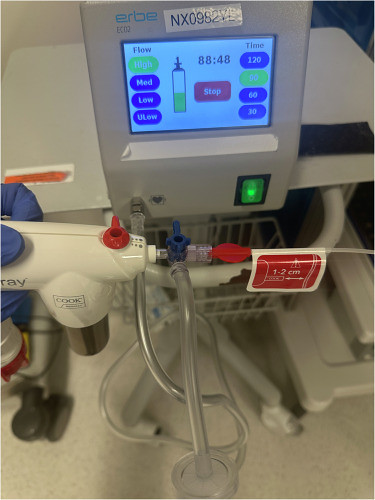
Final set-up. ECO2 insufflator (Erbe Elektromedizin GmbH, Tübingen, Germany).
Read the full article online.
The information presented in Endoscopedia reflects the opinions of the authors and does not represent the position of the American Society for Gastrointestinal Endoscopy (ASGE). ASGE expressly disclaims any warranties or guarantees, expressed or implied, and is not liable for damages of any kind in connection with the material, information, or procedures set forth.

