
Post written by Abdulrahman Qatomah, MBBS, from Gastroenterology, Endoscopy and Hepatology, Brigham and Women’s Hospital, Harvard Medical School, Boston, Massachusetts, USA.

We present a multitraction point (MTP) technique designed to facilitate endoscopic submucosal dissection (ESD) for difficult-to-access colorectal lesions. This approach is particularly useful for large lesions with suboptimal submucosal exposure, where perpendicular rather than tangential dissection access predominates, a situation that significantly increases risk of deep mural injury and colonic perforation.
The MTP technique uses more than 1 rubber band traction device, placed strategically at 2 or more traction points following circumferential incision. These traction points enable progressive access to the submucosa during dissection; once the highest-tension point is released—typically just below the level of each traction point—improved visualization and tissue plane exposure are achieved.
The MTP technique enables endoscopists to perform safer and more efficient ESD for large colorectal lesions located in anatomically challenging sites, such as the hepatic flexure, ascending colon, and cecum. By significantly improving exposure of the submucosal plane, the technique has the potential to reduce risk of deep mural injury and, ultimately, perforation—2 of the most feared adverse events of colorectal ESD.
This video demonstrates how to apply traction strategically at the optimal traction points to maximize submucosal exposure. Endoscopists can learn not only the technical steps of the MTP technique, but also the underlying principles of traction-assisted dissection that can be adapted to a variety of challenging lesion locations.
Notably, the principles of this technique also can be extended to gastric lesions, broadening its potential clinical applicability.
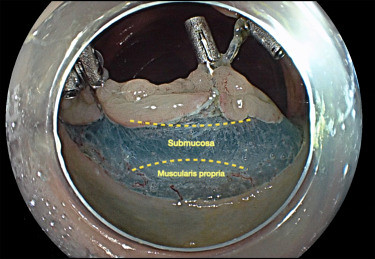
Mutlipoint traction with clear exposure to the submucosa and separation of the muscularis propria.
Read the full article online.
The information presented in Endoscopedia reflects the opinions of the authors and does not represent the position of the American Society for Gastrointestinal Endoscopy (ASGE). ASGE expressly disclaims any warranties or guarantees, expressed or implied, and is not liable for damages of any kind in connection with the material, information, or procedures set forth.

