
Post written by Ernesto Robalino Gonzaga, MD, from the University of Pennsylvania, Philadelphia, Pennsylvania, and Gastroenterology, AdventHealth Medical Group, Orlando, Florida, Saurabh Chandan, MD, from Houston Methodist West Hospital, Houston, Texas, USA, and the Center for Interventional Endoscopy, AdventHealth, and Dennis Yang, MD, from the Center for Interventional Endoscopy, AdventHealth.

Our study evaluates whether a routine esophagram after peroral endoscopic myotomy (POEM) provides meaningful clinical value in otherwise asymptomatic patients.
Although POEM has become a widely performed and highly effective treatment for esophageal motility disorders, postoperative management practices vary significantly among centers.
One of the most debated steps is the routine esophagram performed within 24 to 72 hours after the procedure. Despite the widespread use, the true diagnostic yield and whether it impacts patient care has remained unclear.
As POEM has matured and procedural safety has improved, many of the postoperative habits adopted early in the technique’s evolution have yet to be reassessed with contemporary evidence. Routine esophagrams add radiation exposure, increase cost, and can delay diet advancement or hospital discharge.
Yet, clinicians have lacked consolidated, high-quality data to determine whether this practice remains necessary. Our goal was to provide one of the most comprehensive and clinically relevant evaluations to date on the use of routine post-POEM imaging.
Across 14 studies and 2153 patients, our analysis found that esophageal leaks after POEM are rare. The pooled rates of intramural and extramural leaks were 2.3% and 1.4%, respectively, and nearly all clinically significant leaks occurred in symptomatic patients, meaning routine imaging would not have changed their management. Only a handful of asymptomatic leaks were detected exclusively by imaging.
We also found that common postoperative findings such as pneumoperitoneum and pneumomediastinum were frequent but clinically inconsequential. Overall, routine imaging changed management in only 3.4% of cases. These findings suggest that a selective imaging strategy focused on patients with symptoms or intraprocedural concerns may be more efficient, cost-effective, and clinically appropriate.
Future work should focus on defining clear clinical predictors for when imaging is most valuable and developing standardized postoperative pathways that balance safety with resource use.
Our findings support a shift toward evidence-based postoperative care after POEM, emphasizing patient-specific decision-making rather than routine testing.
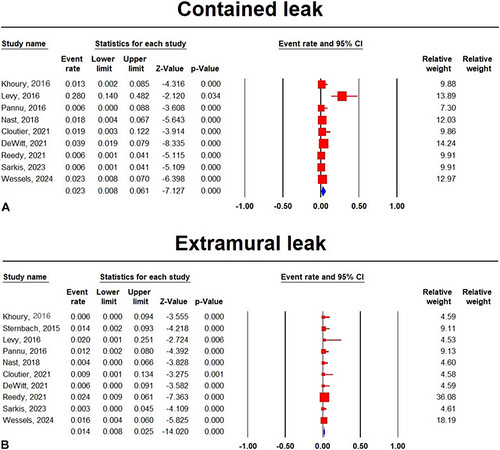
Forrest plot of pooled rates of intramural (A) and extramural (B) esophageal leaks. CI, Confidence interval.
Read the full article online.
The information presented in Endoscopedia reflects the opinions of the authors and does not represent the position of the American Society for Gastrointestinal Endoscopy (ASGE). ASGE expressly disclaims any warranties or guarantees, expressed or implied, and is not liable for damages of any kind in connection with the material, information, or procedures set forth.
 endoscopedia.com