
Post written by Andrew C. Storm, MD, from Wake Forest School of Medicine, Winston-Salem, NC, USA.

I hope you will scope out our manuscript in GIE, “Transmural gallbladder drainage using a novel endosonographic-guided suture (with video),” by Jad P. AbiMansour and our colleagues. Since that preclinical study, the EndoFix device (Softac Medical Technologies Inc, Plainville, Mass, USA) has received U.S. Food and Drug Administration clearance. We have now performed the first several successful clinical gallbladder drainage procedures at Wake Forest University Medical Center (Winston-Salem, NC, USA), using this suture fixation before lumen-apposing metal stent (LAMS) deployment.
The device marries my 2 favorite endoscopic technologies: endoscopic suture application and EUS to enhance the safety and control of transluminal anastomosis creation. A recent growth in the use of LAMSs for novel anastomosis creation has underscored the importance of technologies aimed at improving procedural safety. This may include reducing stent misdeployments, as classified by Ghandour et al1 in the January 2022 issue of GIE, as well as decreasing the target distance and stabilizing the gallbladder prior to electrocautery access.
EndoFix is a FNA device that, through EUS guidance, deploys a preloaded suture tack into the gallbladder. The needle is withdrawn over the suture, allowing traction to draw the gallbladder into apposition with the nearby GI lumen. A cinch is then deployed to secure the construct before placement of a LAMS.
The next step will be exploring the device in real-world clinical practice, including whether it expands access to previously unreachable gallbladders as well as potential roles beyond gallbladder fixation. We are particularly interested in its role in other EUS-guided interventions where controlled apposition may enhance procedural safety and operator confidence.
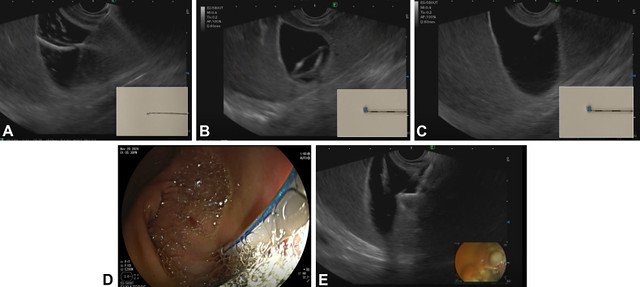
Overview of suture-assisted cholecystogastrostomy with (A) advancement of the suture needle into the gallbladder followed by deployment of the suture tags, (B) gentle tension applied to the suture results in formation of a securement loop, (C) withdrawal of the needle and additional tension on the suture, which allows for manipulation of the gallbladder, (D) suture anchor and lock deployed through the echoendoscope under endoscopic visualization, and (E) freehand deployment of a lumen-apposing metal stent.
Read the full article online.
The information presented in Endoscopedia reflects the opinions of the authors and does not represent the position of the American Society for Gastrointestinal Endoscopy (ASGE). ASGE expressly disclaims any warranties or guarantees, expressed or implied, and is not liable for damages of any kind in connection with the material, information, or procedures set forth.
- Ghandour B, Bejjani M, Irani SS, et al; EUS-GE Study Group. Classification, outcomes, and management of misdeployed stents during EUS-guided gastroenterostomy. Gastrointest Endosc 2022;95:80-9. ↩︎
 endoscopedia.com