
Post written by Amol Bapaye, MD (MS), MSGEI, FISG, FASGE, FJGES, from Shivanand Desai Center for Digestive Disorders, Deenanath Mangeshkar Hospital and Research Center, Pune, India.

The objective of this study was to perform a retrospective comparison of long-term (3-year) gastroesophageal reflux (GER) rates in a matched cohort of patients with achalasia cardia who underwent only peroral endoscopic myotomy (POEM) versus those who underwent POEM with concomitant endoscopic fundoplication (POEM + F), with a particular focus on objective GER outcomes.
Although POEM is an established treatment modality for achalasia, post-POEM GER has emerged as a significant concern. Two previous single-arm case series on POEM + F–a pilot series from Inoue et al1 and our own single-arm have demonstrated low GER rates after POEM + F at up to 1-year follow-up. However, this had not been validated in comparative studies at longer-term follow-up. This motivated us to conduct this retrospective study that compared long-term GER outcomes in 2 matched groups of patients with achalasia undergoing POEM versus POEM + F.
In our study, at 3-year follow-up, the incidence of objective GER (defined by esophageal acid exposure time >6% and/or grade B or higher esophagitis) was significantly higher in the POEM group than the POEM + F group. Yet, subjective (symptomatic) GER (based on GERD questionnaire, Reflux Symptom Index, GERD health-related quality of life) was comparable between the groups. This highlights the fact that the majority of post-POEM GER may remain asymptomatic, identifiable only by high esophageal acid exposure time or presence of erosive esophagitis. Wrap integrity was well maintained at 3-year follow-up in the POEM + F group. Both groups demonstrated excellent clinical success and adverse event profiles.
POEM + F may be considered as the primary option for patients who are at a higher risk of developing post-POEM GER. Further randomized studies are required to confirm these findings.
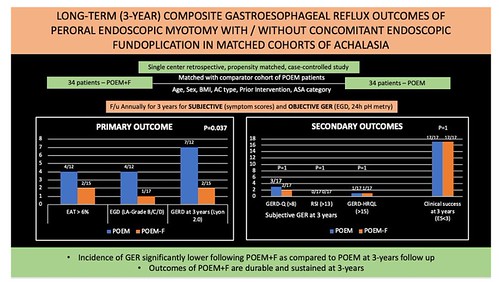
Graphical abstract
Read the full article online.
The information presented in Endoscopedia reflects the opinions of the authors and does not represent the position of the American Society for Gastrointestinal Endoscopy (ASGE). ASGE expressly disclaims any warranties or guarantees, expressed or implied, and is not liable for damages of any kind in connection with the material, information, or procedures set forth.
- Inoue H, Ueno A, Shimamura Y, et al. Peroral endoscopic myotomy and fundoplication: a novel NOTES procedure. Endoscopy 2019;51:161-4. ↩︎
 endoscopedia.com