
GIE Senior Associate Editor David L. Diehl, MD, highlights this article from the February issue: “Long-term (3-year) composite gastroesophageal reflux outcomes of peroral endoscopic myotomy with or without concomitant endoscopic fundoplication in matched cohorts of achalasia” by Amol Bapaye, MD (MS), MSGEI, FISG, FASGE, FJGES, et al.

To POEM or to POEM + F?
In recent years, most advanced esophageal programs have gone to a “peroral endoscopic myotomy (POEM)-first” approach to the management of achalasia, shifting pneumatic dilation (PD) to a distant secondary role and decreasing use of Heller myotomy. A landmark prospective randomized trial1 showed that although PD is effective, POEM leads to less need for reintervention by the 2-year mark.
An important concern with POEM has been with the higher rate of gastroesophageal reflux (GER) compared with PD. The GER is usually silent but can present with erosive esophagitis and even progression to Barrett’s mucosa, with the associated risk of malignancy.
In 2019, Inoue et al2 described the so-called POEM + fundoplication (POEM + F) procedure in which, after anterior myotomy, the endoscope is advanced, natural orifice transluminal endoscopic surgery (NOTES) style, into the peritoneum. Fundic serosa is grasped, retracted, and clipped in place to create a Dor-like fundoplication. Since Inoue et al’s initial report, interest in POEM + F has continued to grow, and enough data are available to generate a recent meta-analysis3 that supports the finding that POEM + F can mitigate post-POEM GER.
In the February 2026 issue of GIE, Bapaye et al report on their experience with POEM + F. The study is a retrospective look at POEM + F outcomes compared with that of a matched historical control group, with an impressive 3-year follow-up. Similar to other published studies, less GER was found in the POEM + F group. Completion of the NOTES fundoplication added approximately 1 hour to the POEM procedure, and a single very experienced operator performed all the procedures.
The 3-year follow-up is a unique aspect about this study. The authors noted wrap loosening in about 25% of cases at the 3-year mark, which is still very robust. This is in line with other POEM + F studies in the literature of shorter follow-up. This study sheds light on the durability of an endoscopic NOTES approach fundoplication.
However, we still need more data on how often POEM + F should be performed, as a large percentage of POEM-only patients do not seem to have symptomatic GER and will not develop Barrett’s. The optimal technique of POEM + F also needs to be worked out.
Current POEM practice has improved and become more refined in recent years, with closer attention paid to the length of myotomy on the stomach and preservation of the sling muscle fibers. These modifications produce good POEM results while decreasing the amount of GER.
As more interventional endoscopists are adopting POEM in their practice, further training opportunities in POEM + F will be needed. Intentionally entering the peritoneum NOTES style is not for the faint of heart nor for those without extensive experience and training. Compared with POEM alone, POEM + F is a completely different beast. Even more important is to figure out who needs POEM + F at all, compared with POEM without endoscopic fundoplication.
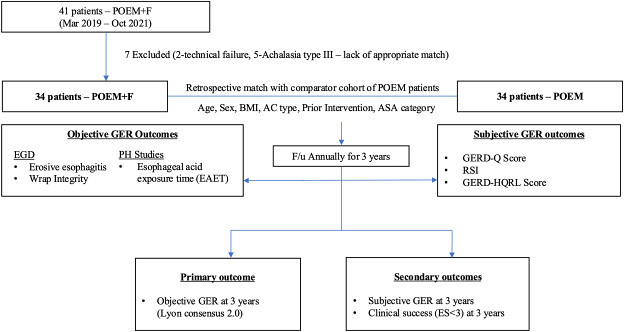
Consolidated Standards of Reporting Trials Diagram describing patient recruitment for the study. POEM + F, Peroral endoscopic myotomy + endoscopic fundoplication; POEM, peroral endoscopic myotomy; BMI, body mass index; AC, achalasia cardia; GER, gastroesophageal reflux; ASA, American Society of Anesthesiologists; F/u, follow-up; GERD-Q, GERD questionnaire; RSI, Reflux Symptom Index; GERD-HRQL, GERD health-related quality of life; ES, Eckardt score.
Read the full article online.
The information presented in Endoscopedia reflects the opinions of the authors and does not represent the position of the American Society for Gastrointestinal Endoscopy (ASGE). ASGE expressly disclaims any warranties or guarantees, expressed or implied, and is not liable for damages of any kind in connection with the material, information, or procedures set forth.
- Ponds FA, Fockens P, Lei A, et al. Effect of peroral endoscopic myotomy vs pneumatic dilation on symptom severity and treatment outcomes among treatment-naive patients with achalasia: a randomized clinical trial. JAMA 2019;322:134-44. ↩︎
- Inoue H, Ueno A, Shimamura Y, et al. Peroral endoscopic myotomy and fundoplication: a novel NOTES procedure. Endoscopy 2019;51:161-4. ↩︎
- Gopakumar H, Annor E, Vohra I, et al. Peroral endoscopic myotomy with fundoplication (POEM-F) for achalasia: Systematic review and meta-analysis. Endosc Int Open 2025;13:a25368132. ↩︎
 endoscopedia.com