
Post written by Yasi Xiao, MD, from the Division of Gastroenterology and Hepatology, Thomas Jefferson University Hospitals, Philadelphia, Pennsylvania, and Dennis Yang, MD, from the Center for Interventional Endoscopy, AdventHealth, Orlando, Florida, USA.

The aim of this study was to evaluate the status of training with lumen-apposing metal stents (LAMSs) for therapeutic endoscopic ultrasound (EUS) during advanced endoscopy training.
The introduction of the LAMS has revolutionized the field of therapeutic EUS. Despite its widespread use, there is paucity of data on the learning curve and training on the use of LAMSs for various therapeutic EUS procedures.
The study comprised a 15-question survey questionnaire to 92 advanced endoscopy trainees regarding their training on the use of LAMSs, out of which 43 responded. Although trainees reported a median of 14 hands-on cases for EUS-guided LAMS placement for peripancreatic fluid collections, hands-on opportunities for other LAMS indications (gallbladder drainage, choledochoduodenostomy, EUS-directed transgastric cholangiopancreatography) were relatively limited (median of 1-2 cases hands-on cases throughout fellowship).
In all, the study demonstrates that training opportunities for EUS-guided LAMS placement beyond pancreatic fluid collections remain limited. Given that hands-on participation was reported as the main factor determining a trainee’s level of confidence in performing these procedures during independent practice, additional training pathways must be developed.
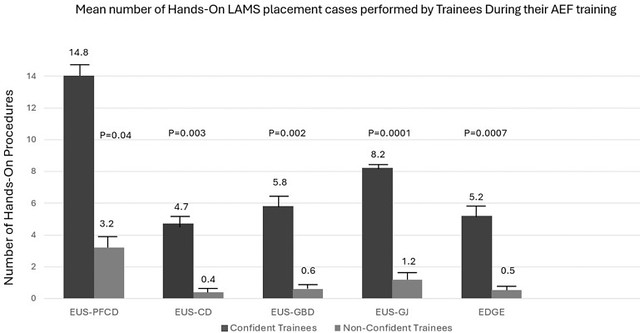
Comparison of the mean number of hands-on lumen-apposing metal stent (LAMS) placement cases performed by advanced endoscopy fellowship (AEF) trainees who were confident versus not confident with performing specific procedures. EDGE, endoscopic ultrasound (EUS)-directed transgastric endoscopic retrograde cholangiopancreatography; EUS-CD, EUS-guided choledochoduodenostomy; EUS-GBD, EUS-guided gallbladder drainage; EUS-GJ, EUS-guided gastrojejunostomy; EUS-PFCD, EUS-guided drainage of peripancreatic fluid collection drainage.
Visit iGIE’s Facebook, X/Twitter, LinkedIn, Instagram, and YouTube accounts for more content from the ASGE peer-reviewed journal that launched in December 2022 and has been PubMed indexed.
Read the full article online.
The information presented in Endoscopedia reflects the opinions of the authors and does not represent the position of the American Society for Gastrointestinal Endoscopy (ASGE). ASGE expressly disclaims any warranties or guarantees, expressed or implied, and is not liable for damages of any kind in connection with the material, information, or procedures set forth.

