
Post written by Agnieszka Maniak, MD, and Irving Waxman, MD, from Rush University Medical Center, Center for Interventional Endoscopy, Chicago, Illinois, USA.

Our case features a 74-year-old woman who presented with recurrent hematochezia despite conventional endoscopic hemostasis following endoscopic submucosal dissection (ESD) of a 50-mm rectal polyp. During her second presentation for hematochezia, the patient underwent a CT angiography that revealed an actively bleeding rectal pseudoaneurysm arising from a branch of the superior rectal artery.
She subsequently underwent flexible sigmoidoscopy with EUS-guided absorbable gelatin sponge injection to target the culprit vessel with an immediate decrease in Doppler flow. The patient recovered well with no further bleeding episodes.

This case highlights application of a well-described endoscopic technique in a novel clinical scenario. EUS-guided glue embolization is an established treatment for gastric varices, but data on EUS-guided therapy for pseudoaneurysms are limited.
Here, we adapted the approach to manage a persistent lower GI bleed caused by a rectal pseudoaneurysm following ESD. Not only does this case serve as an important reminder to consider less-common etiologies, such as pseudoaneurysms, when evaluating postresection bleeding, it demonstrates successful endoscopic therapy of an adverse event traditionally managed by interventional radiology.
Although a visible vessel in the resection bed may appear to be the obvious culprit, persistent bleeding that does not fit the expected clinical pattern warrants investigation for alternative etiologies. Leveraging our diagnostic and therapeutic endoscopic tools when the clinical picture does not fit the typical mold is essential.
We hope this case reinforces that not all post-ESD bleeds are treated the same. EUS-guided embolization may be a safer alternative to angiography in a select patient population and can be added to one’s toolbox when managing challenging bleeding cases. By sharing this case, we aim to show that EUS-guided glue embolization with absorbable gelatin sponge injection merits consideration as a valuable addition to the algorithm for complex GI bleeding.
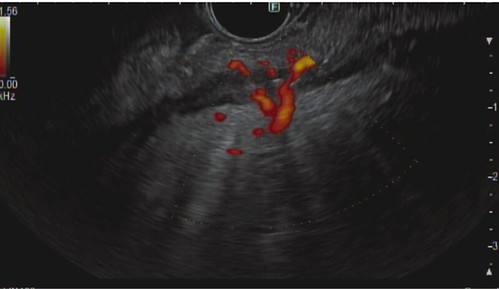
EUS with Doppler demonstrating the feeder arterial vessel.
Read the full article online.
The information presented in Endoscopedia reflects the opinions of the authors and does not represent the position of the American Society for Gastrointestinal Endoscopy (ASGE). ASGE expressly disclaims any warranties or guarantees, expressed or implied, and is not liable for damages of any kind in connection with the material, information, or procedures set forth.
 endoscopedia.com