
Post written by Martin C.S. Wong, MD, and Junjie Huang, PhD, from The Jockey Club School of Public Health and Primary Care, Faculty of Medicine, The Chinese University of Hong Kong, Shatin, Hong Kong.

The incidence and mortality of early-onset colorectal cancer (CRC) have been increasing in many parts of the world. The American Cancer Society and the U.S. Preventive Services Task Force have recommended CRC screening starting from age 45–and advancing earlier screening has been associated with a greater reduction of CRC risk when compared with screening starting at age 50.
However, many Asia Pacific regions such as Hong Kong maintain the starting age for screening at 50. Hence, we wonder if earlier screening starting at age 45 may represent a cost-effective approach.
The findings from this study may inform physicians and policymakers to revisit the starting age for screening, as early-onset CRC is growing rapidly in many parts of the world. We selected a developed city in Asia Pacific (Hong Kong) in hopes to examine if earlier screening may be economically favorable. This study also may assist policies to combat the rising incidence of early-onset CRC.
Our results based on a Markov decision model compared the cost-effectiveness of CRC screening starting from ages 40, 45, and 50 up to 75 between screening programs using fecal immunochemical tests versus colonoscopy as the primary screening tool. We demonstrated that the incremental cost-effectiveness ratio was the lowest in the fecal immunochemical test group initiating screening at age 50. Nevertheless, when we take into account the total number of CRC cases, total loss of cancer-related life-years, cases of CRC prevented, life-years saved, and total costs per life-years saved, screening at age 45 represents a balanced approach that also may assist with the rising incidence of early-onset CRC.
The findings are restricted to a single city and, to enhance generalizability, future economic studies are needed in other countries/cities where early-onset CRC also is observed.
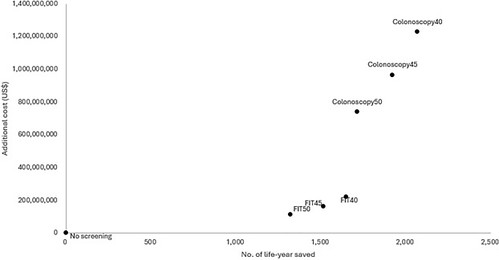
Life-year saved and additional cost for different colorectal cancer screening strategies. U.S.$, U.S. dollars; FIT, fecal immunochemistry test.
Read the full article online.
The information presented in Endoscopedia reflects the opinions of the authors and does not represent the position of the American Society for Gastrointestinal Endoscopy (ASGE). ASGE expressly disclaims any warranties or guarantees, expressed or implied, and is not liable for damages of any kind in connection with the material, information, or procedures set forth.
 endoscopedia.com