
Post written by Carlos Robles-Medranda, MD, FASGE, AGAF, from Instituto Ecuatoriano de Enfermedades Digestivas, Guayaquil, Ecuador.

This video presents 2 clinical cases demonstrating the use of a second-generation motorized fine-needle biopsy (mFNB) device (Precision-GI; Limaca Medical, Ein Ha Emeq, Israel) for EUS-guided tissue acquisition in hepatic and pancreatic lesions.
The first case involves a 56-year-old woman with a history of chronic liver disease. Prior imaging with abdominal ultrasound and elastography suggested discordant findings regarding steatosis and fibrosis. EUS evaluation revealed a hyperechogenic liver, and biopsies of both hepatic lobes were performed using a 20-gauge mFNB. The procedure was completed without adverse events. Histological analysis confirmed micronodular cirrhosis with mild steatosis and fibrosis, with adequate core tissue and preserved architecture.
The second case describes a 60-year-old woman presenting with jaundice and constitutional symptoms. Imaging showed biliary duct dilation and a pancreatic head mass. EUS identified a hypoechoic solid lesion, and tissue acquisition was performed using the same 20-gauge mFNB device. The procedure was uneventful, and pathology confirmed acinar cell carcinoma with adequate noncontaminated core tissue. The video highlights the technical aspects of the motorized biopsy system, including controlled needle advancement and rotational coring, allowing for efficient acquisition of high-quality tissue samples and no adverse events in both cases.
This video showcases the practical application of a novel second-generation mFNB device during EUS-guided tissue acquisition. Given that this technology represents a significant advancement over conventional manual techniques, visual demonstration is essential to illustrate its unique mechanism—specifically, the automated axial advancement combined with synchronized rotational coring.
Endoscopists can appreciate several key points from our experience. First, the mFNB device simplifies tissue acquisition by eliminating the need for repeated manual thrusting, potentially reducing technical variability. Second, the ability to obtain high-quality core samples with preserved architecture and no blood contamination displays its diagnostic reliability, even with a limited number of passes. Third, its safe application in liver and pancreatic lesions suggests versatility across different EUS-guided indications. Finally, this technology may contribute to shorter procedure times and improved standardization of tissue acquisition, which are critical factors in high-volume or technically demanding settings.
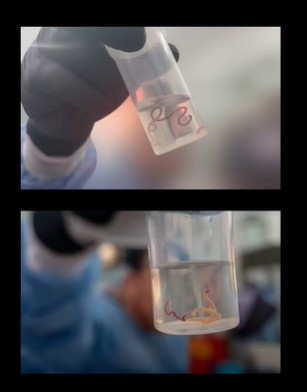
Case 1 from the video.
Read the full article online.
The information presented in Endoscopedia reflects the opinions of the authors and does not represent the position of the American Society for Gastrointestinal Endoscopy (ASGE). ASGE expressly disclaims any warranties or guarantees, expressed or implied, and is not liable for damages of any kind in connection with the material, information, or procedures set forth.
 endoscopedia.com