
Post written by Edward J. Despott, MD, FRCP, FEBGH, FASGE, MD (Res), Elisabet Maristany Bosch, MD, and Georgios Kalopitas, MD, PhD, from the Royal Free Unit for Endoscopy, The Royal Free Hospital and University College London Institute for Liver and Digestive Health, London, United Kingdom.
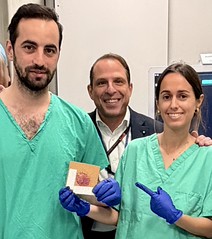
Our video showcases the practical implementation of the “Asclepius tube,” an innovative, simple drainage system designed for endoscopic submucosal dissection (ESD). It consists of a slim fenestrated (8F nasojejunal) drainage tube wrapped around the scope, allowing for continuous drainage of any gas or fluid from the lumen, obviating the need for endoscopic aspiration through the scope.
Our video demonstrates the straightforward set-up of the Asclepius tube step by step and its practical application during ESD of a large rectal lesion. As is our standard practice, the saline-immersion/irrigation technique (SITE) was used for ESD. The drainage tube was wrapped around the scope and attached to continuous low-flow suction during the procedure, allowing for more efficient dissection, keeping only about 500 mL of saline within the lumen, avoiding overdistension of the bowel and maintaining patient comfort and stable access to the submucosal layer.
Colorectal ESD can be technically demanding, mainly because of difficulty in the maintenance of scope stability and optimal visualization. SITE was introduced to overcome the drawbacks associated with gaseous insufflation by improving visualization and facilitating natural traction through buoyancy, enhanced conductivity, and increased patient comfort (especially when combined with drainage). The absence of an adjunctive drainage tube requires repeated through-the-scope suction of any redundant fluid/gas; this interrupts workflow and increases procedure time.
The Asclepius tube offers a simple, low-cost yet highly effective additional tool when combined with SITE, obviating the need for endoscopic aspiration through the scope, with a smoother dissection process and enhanced patient comfort through elimination of overdistension. In our opinion, this deserves wider exposure because it uses readily available materials and could be easily adopted in diverse practice settings to enhance ESD performance and patient comfort.
This video serves as a demonstration for a simple, practical, and reproducible way to set up and use the Asclepius tube, so that it is quick to assemble and does not interfere with scope maneuverability. Correct securing of the tube to the endoscope is the main critical step to ensure good function, smooth scope insertion, and stable handling, without added friction or loss of tip control and maintenance of patient comfort. In our practice, we use SITE in conjunction with the Asclepius tube universally for all our ESD procedures.
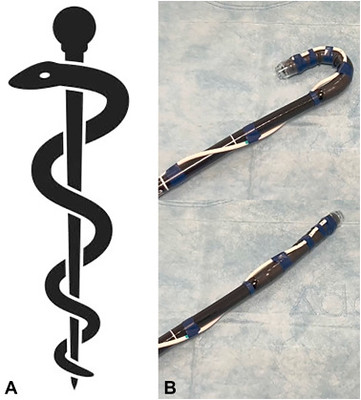
Graphic symbol of “the rod of Asclepius” (A), and photograph (B) of the maintained flexibility of the scope with the Asclepius tube wrapped around.
Read the full article online.
The information presented in Endoscopedia reflects the opinions of the authors and does not represent the position of the American Society for Gastrointestinal Endoscopy (ASGE). ASGE expressly disclaims any warranties or guarantees, expressed or implied, and is not liable for damages of any kind in connection with the material, information, or procedures set forth.
 endoscopedia.com