
Post written by Ahmad Madkour, MD, and Amr Elfouly, MD, from the Endemic Medicine Department, Faculty of Medicine, Helwan University, Cairo, and Hassan Atalla, MD, from the Hepatology and Gastroenterology Unit, Department of Internal Medicine, Faculty of Medicine, Mansoura University, Mansoura, Egypt.

Esophageal fibrovascular polyps are rare benign tumors. Huge polyps usually necessitate an aggressive type of surgery.
Endoscopic removal of such large polyps presents several challenges, including their considerable size, presence of a substantial fibrovascular core with risk of significant bleeding, difficulties in extracting the polyp, and management of the remaining fleshy stump after resection.
We present the resection of a giant fibrovascular polyp using an endoscopic submucosal dissection (ESD) technique followed by band ligation of the residual stump.

ESD was feasible and effective, with subsequent resolution of the presenting symptoms.
ESD allowed us to overcome the anticipated technical challenges by enabling direct hemostasis of massive intraprocedural bleeding, facilitating en bloc resection of the lesion.

Final extraction of the specimen was accomplished in a piecemeal manner. In addition, band ligation of the fleshy stump proved beneficial in preventing potential airway obstruction caused by bulky residual tissue.
ESD was feasible and should be considered as a salvage option for such risky giant fibrovascular polyps.
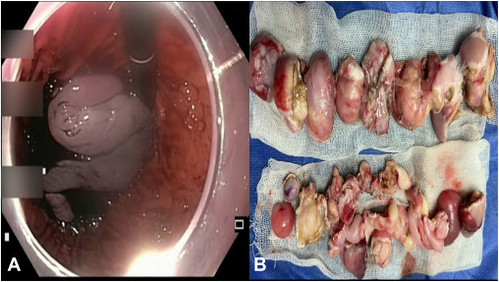
Endoscopic view showing the resected polyp lying within the gastric fundus (A), after which it was retrieved in a piecemeal fashion (B).
Read the full article online.
The information presented in Endoscopedia reflects the opinions of the authors and does not represent the position of the American Society for Gastrointestinal Endoscopy (ASGE). ASGE expressly disclaims any warranties or guarantees, expressed or implied, and is not liable for damages of any kind in connection with the material, information, or procedures set forth.
 endoscopedia.com