
Post written by Pierce L. Claassen, MD, from Mayo Clinic, Internal Medicine, Scottsdale, Arizona, USA.

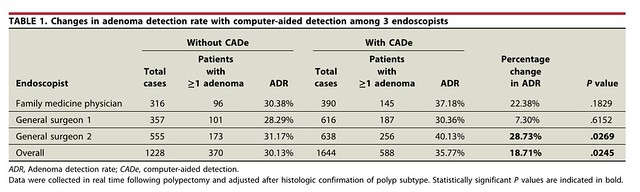
The focus of our study was to evaluate the benefit of using computer-aided detection (CADe) in a rural medical center. It is known that CADe has the potential to increase adenoma detection rate (ADR), which is known to be associated with decreased interval colorectal cancer incidence and mortality.
CADe has been studied in tertiary medical centers with gastroenterologists performing the majority of endoscopy; however, studies examining the impact of this technology on nongastroenterologist endoscopists are lacking, to our knowledge. In rural America, it is estimated that more than 50% of colonoscopies are performed by nongastroenterologist endoscopists.
At our rural Critical Access Hospital (Pullman Regional Hospital in Pullman, Wash, USA), 2 general surgeons and 1 family medicine physician perform all endoscopies. To our knowledge, this is the first and only study that has explored the impact of CADe on ADR among nongastroenterologists performing colonoscopies at a rural medical center.
Our study found that CADe was able to increase groupwide ADR by a magnitude of 18.71% above baseline. This study suggests that CADe technology may be a reasonable way to increase ADR in rural areas where nongastroenterologists are known to perform a significant proportion of endoscopies. By offering high-quality colorectal cancer screening colonoscopies, we can hope to lessen the colorectal cancer disparities known to impact patients in rural and underserved areas.
We would like to thank the American Society for Gastrointestinal Endoscopy for making this study possible. The CADe endoscopy modules used were granted to Pullman Regional Hospital through the Health Equity Assistance Program.
Visit iGIE’s Facebook, X/Twitter, LinkedIn, Instagram, and YouTube accounts for more content from the ASGE peer-reviewed journal that launched in December 2022 and has been PubMed indexed.
Read the full article online.
The information presented in Endoscopedia reflects the opinions of the authors and does not represent the position of the American Society for Gastrointestinal Endoscopy (ASGE). ASGE expressly disclaims any warranties or guarantees, expressed or implied, and is not liable for damages of any kind in connection with the material, information, or procedures set forth.
 endoscopedia.com