
Post written by Prakash Zacharias, MD, DM, and Mathew Philip, MD, DM, from the Lisie Institute of Gastroenterology, Hepatology and Transplantation, Lisie Hospital, Kochi, India.
This article highlights the application of a third-space endoscopic technique to restore luminal continuity in a patient with complete esophageal obstruction at the postcricoid region. We successfully created a neo-lumen by performing submucosal tunneling from both sides of the obstruction, followed by temporary placement of a fully covered self-expandable metal stent to maintain patency.
Complete esophageal obstruction is an uncommon and challenging clinical scenario. The difficulty is further amplified when the obstruction is located in the postcricoid region, where the confined anatomical space restricts maneuverability. Demonstrating a feasible, third-space approach in such circumstances may be valuable to clinicians facing similar situations.
This case illustrates that submucosal tunneling can be a viable therapeutic option for re-establishing luminal access in patients with complete esophageal obstruction. It expands the endoscopic options available for complex strictures in anatomically constrained regions.
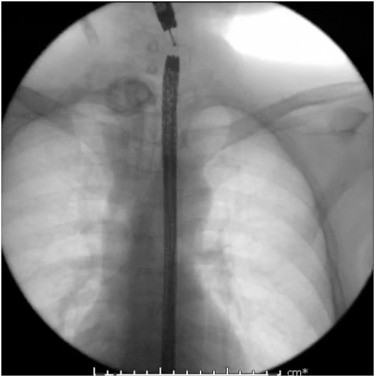
Fluoroscopy showing 2 endoscopes with tunnel creation.
Read the full article online.
The information presented in Endoscopedia reflects the opinions of the authors and does not represent the position of the American Society for Gastrointestinal Endoscopy (ASGE). ASGE expressly disclaims any warranties or guarantees, expressed or implied, and is not liable for damages of any kind in connection with the material, information, or procedures set forth.
 endoscopedia.com