
Post written by Manas Kumar Panigrahi, MD, DM, FRCP (Edin), from the Department of Gastroenterology, All India Institute of Medical Sciences, Bhubaneswar, India.

The focus of our study was to improve on existing methods of bowel preparation in colonoscopy. Bowel preparation is the most important determinant of a proper colonoscopy. Inadequate bowel preparation often leads to missed lesions on colonoscopy. Shankha prakshalana (SP) is an ancient yogic technique known to cleanse the bowel. We decided to focus on this yogic technique to evaluate its effectiveness in bowel preparation for colonoscopy.
Colonoscopy requires adequate bowel preparation for proper mucosal examination to detect and diagnose colorectal lesions. Polyethylene glycol (PG) electrolyte solution in a split-dose regimen is one of the most commonly used methods for bowel preparation. However, this regimen often leads to disturbed sleep and inconvenience for patients while traveling to the hospital. The volume of solution to be ingested and its disagreeable taste may prove to be hindrances in patient acceptability.
SP simply involves drinking saline water followed by 5 yogic postures (asanas). It can be performed within a few hours before the planned procedure, is better tolerated, and causes less inconvenience to the patient. To our knowledge, SP as a bowel preparation method has not been studied widely. Therefore, we designed this study to compare the efficacy and safety of SP with split-dose PG preparation in bowel cleansing for colonoscopy.
A total of 94 patients were enrolled, with 47 in each study group. The mean Boston Bowel Preparation Scale for the whole colon and the segmental Boston Bowel Preparation Scale for the right side of the colon in the SP group was higher than that in the PG group. Adverse effects such as nausea, bloating, and disturbed sleep were significantly more frequent in the PG group than in the SP group.
In conclusion, the traditional yogic technique of SP is an effective, acceptable, affordable, and relatively safe method of bowel preparation for colonoscopy. We feel that this method of bowel cleansing could be leveraged for applicability in patients with chronic constipation who get inadequate relief with medical management.
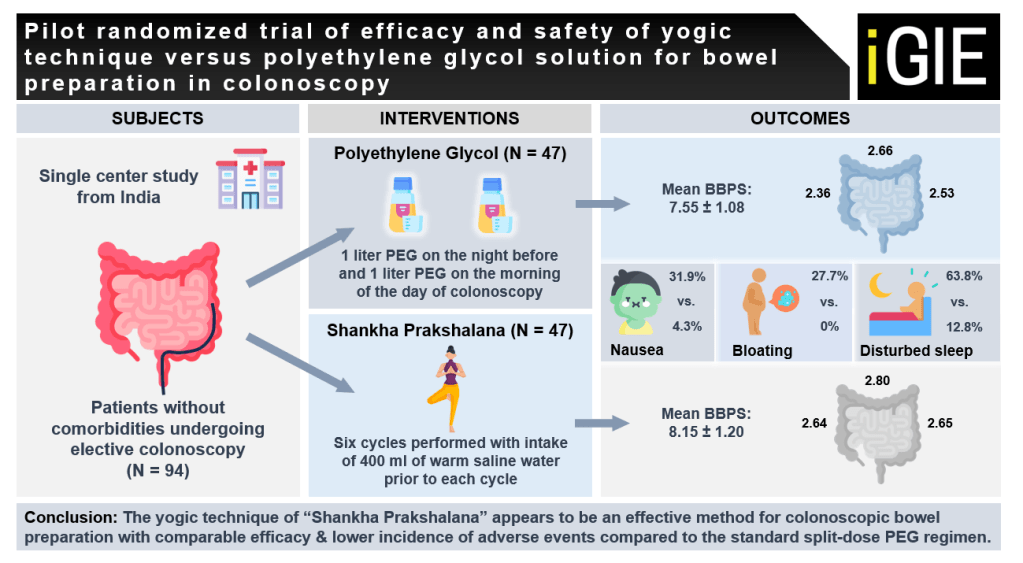
Graphical abstract
Visit iGIE’s Facebook, X/Twitter, LinkedIn, Instagram, and YouTube accounts for more content from the ASGE peer-reviewed journal that launched in December 2022.
Read the full article online.
The information presented in Endoscopedia reflects the opinions of the authors and does not represent the position of the American Society for Gastrointestinal Endoscopy (ASGE). ASGE expressly disclaims any warranties or guarantees, expressed or implied, and is not liable for damages of any kind in connection with the material, information, or procedures set forth.
 endoscopedia.com